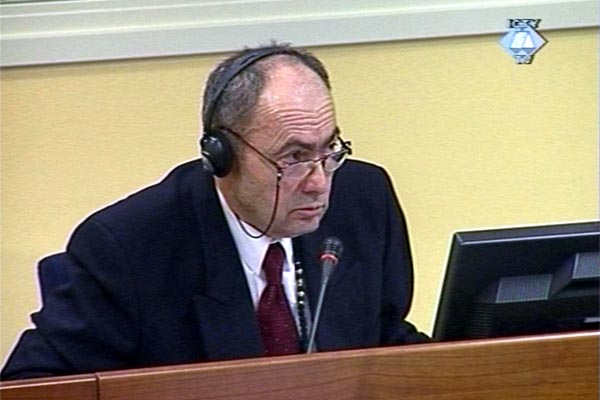
 Zdravko Tolimir in the courtroom Zdravko Tolimir in the courtroom
 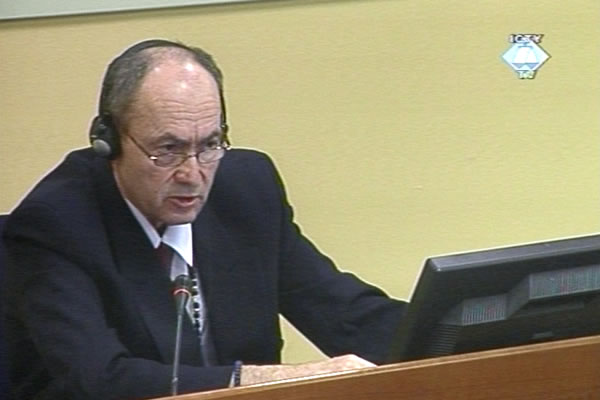 Zdravko Tolimir in the courtroom
 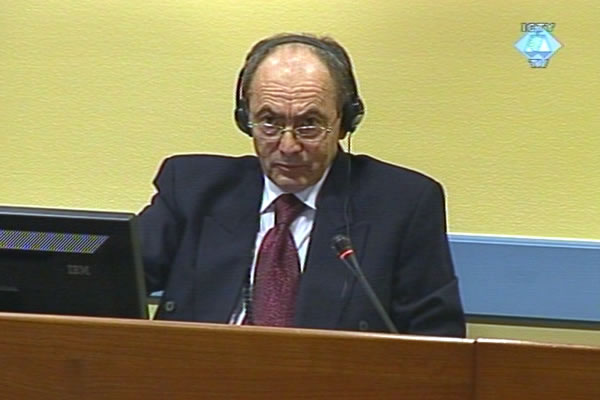 Zdravko Tolimir in the courtroom
 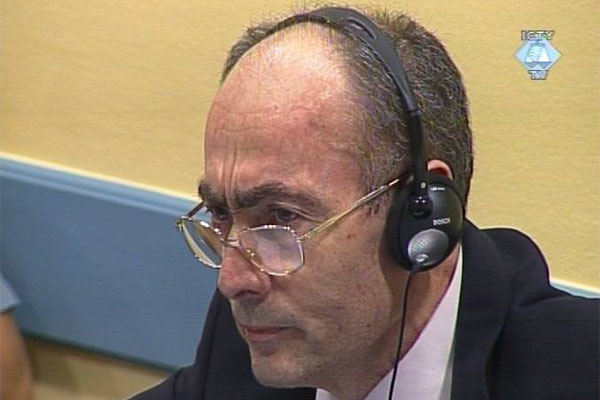 Zdravko Tolimir in the courtroom
 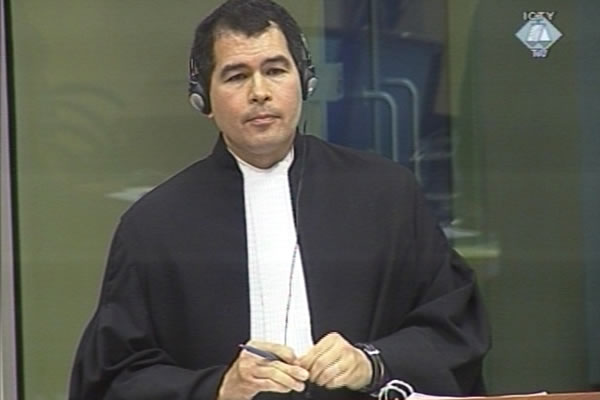 Nelson Thayer, , prosecutor at the Zdravko Tolimir trial Zdravko Tolimir in the courtroom
  PW 023, witness at the Zdravko Tolimir trial
  Mevludin Oric, witness at the Zdravko Tolimir trial
  Jean Rene Ruez, witness at the Zdravko Tolimir trial
 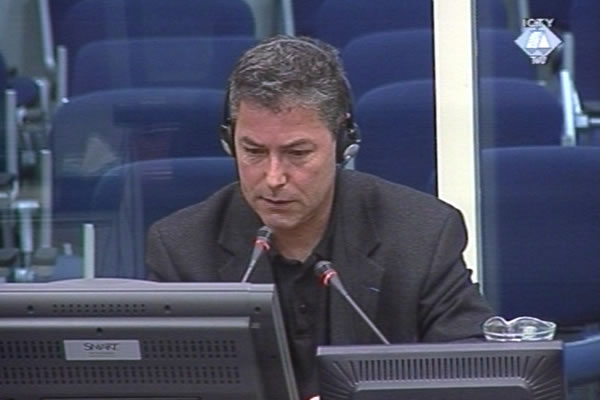 Jean Rene Ruez, witness at the Zdravko Tolimir trial
 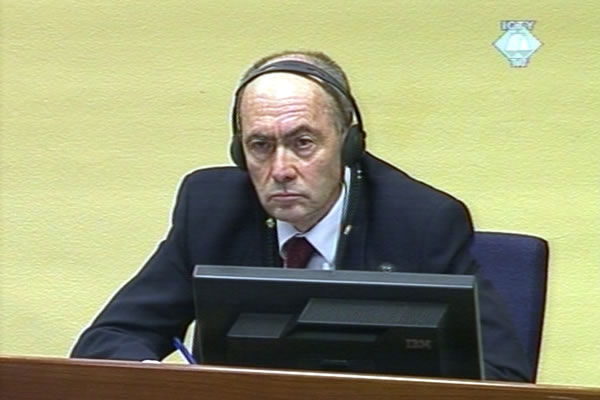 Zdravko Tolimir u sudnici Tribunala
 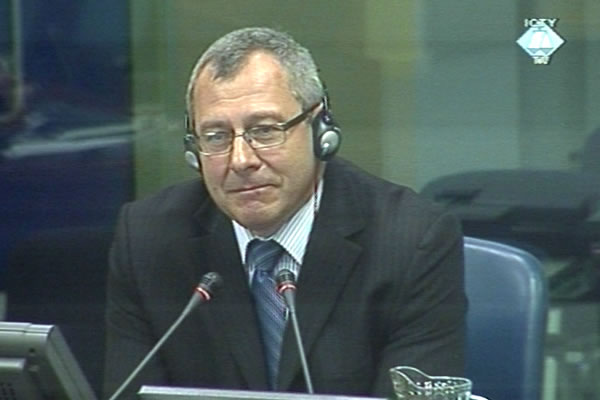 Tomasz Blaszczyk, witness at the Zdravko Tolimir trial
 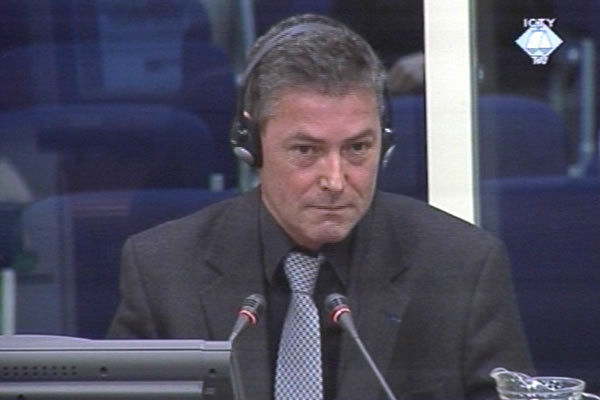 Jean-Rene Ruez, witness at the Zdravko Tolimir trial
  "Rezolucija 819" film poster
 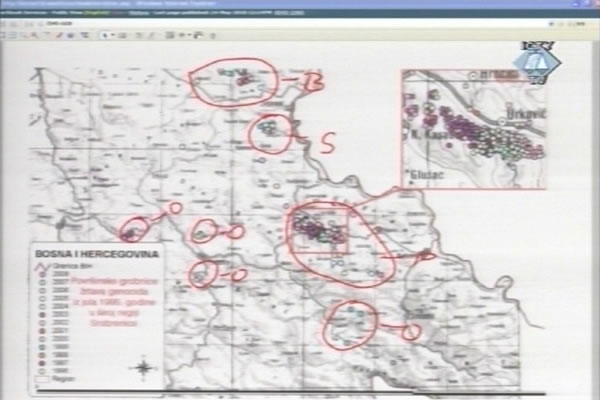 Map marking all the graves identified in the Srebrenica area and one grave containing victims of a crime in Zepa
 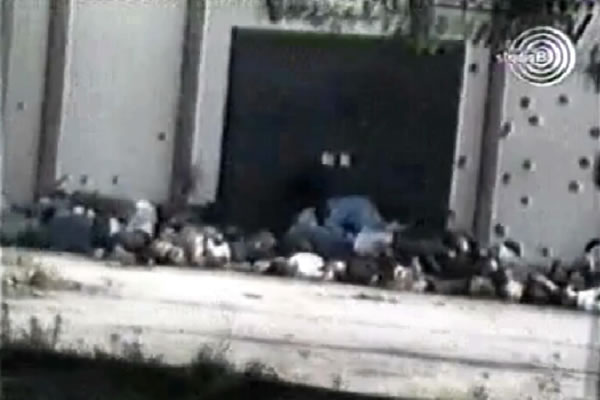 The footage made in front of the Kravica wearhouse shows about twenty bodies piled up
 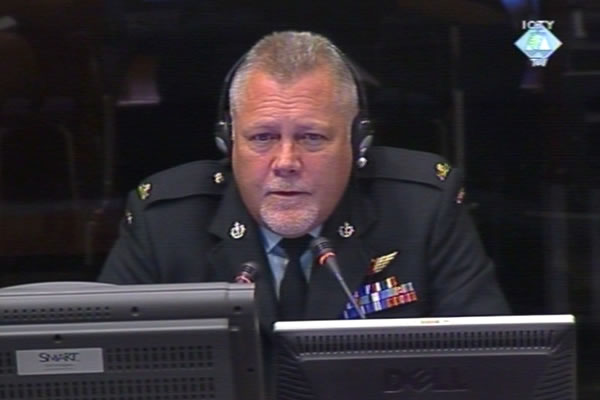 Louis Fortin, witness at the Zdravko Tolimir trial
  Robert Franken, witness at the Zdravko Tolimir trial
  Robert Franken, witness at the Zdravko Tolimir trial
  Cornelis Nicolai, witness at the Zdravko Tolimir trial
 In his evidence, Franken said that the Dutch soldiers were denied access to one part of the enclave, known as the ‘Bandera Triangle’; he showed the court where this area was on the map of the enclave. Today Tolimir showed this map to General Nicolai, who nevertheless maintained he had received no reports to that effect. As far as Nicolai knew, UNPROFOR’s movement within the enclave was never restricted. ‘This still surprises me’, Nicolai said.
General Tolimir, Mladic’s assistant commander for security in the VRS Main Staff, brought up a series of documents to show that the BH Army violated the agreement on the demilitarization of Srebrenica and Zepa after the establishment of the ‘protected areas’ in March 1993. Nicolai agreed that Srebrenica was never completely demilitarized. On the other hand, Nicolai rejected Tolimir’s suggestion that UNPROFOR tolerated the illegal efforts to supply arms to the BH Army in the enclave. Nicolai reminded the court that the no-fly zone was established precisely to limit those activities. The no-fly zone significantly reduced the number of helicopters overflights, used to supply weapons, but it was impossible to put a stop to those activities because of the rugged terrain.
In the final part of his cross-examination of the Dutch general, Tolimir focused on the claim that UNPROFOR was biased, favoring the Muslim side. Tolimir put it to Nicolai that three days after the VRS attacked the enclave, UNPROFOR ‘was working on securing political preconditions for NATO air support” although the situation in the field didn’t call for that. Nicolai dismissed the suggestion, saying that on 9 July 1995 he relayed to the Dutch Battalion General Janvier’s order to take positions in the eastern part of the Srebrenica enclave. This meant that the Bosnian Serbs would have to attack the UN troops if they wanted to continue their onslaught on the enclave.
As Nicolai explained, this was the French general’s response to the Dutch demands for air support. Janvier believed that air support could not be approved unless there was a direct engagement between the Serb forces and the UN and unless civilians came under attack. If the VRS were to attack the blue helmets, the UN troops could return fire and call in NATO air support.
The accused finally asked the Dutch general to comment on the evidence of Canadian officer Louis Fortin. The assistant commander in the UN Sarajevo Sector claimed that ‘UNPROFOR would punish only the Serbs because they considered the Serbs to be the aggressors in the war’. Nicolai tersely said he found the remark to be ‘total nonsense’.
Zdravko Tolimir in the courtroom The witness confirmed that the enclave was never ‘ever entirely demilitarized’ as its defenders had kept their light infantry weapons. The witness also verified that arms continued to be brought into the enclave in the second half of 1994 with helicopters. The weapons were used in actions by the Zepa Brigade, under Palic’s command, targeting the Serb positions outside of the enclave as a ‘part of an operation to lift the siege of Sarajevo and to ease the pressure on the Sarajevo front’, the witness recounted.
The political leadership in Zepa was not officially informed about those attacks and was against them. This led to a disagreement between the military and political elements in the Zepa War Presidency. General Palic received his orders through the military chain of command, the witness said.
The day after the fall of Srebrenica, on 12 July 1995, the VRS called the War Presidency of Zepa to negotiate the evacuation of the enclave. Although the War Presidency forwarded this invitation to the political and military leadership in Sarajevo, members of the War Presidency decided – without receiving a reply – to accept the invitation. Two members, the witness and Mujo Omanovic, were appointed to negotiate.
On 13 July 1995, a two-member delegation from Zepa met with VRS general Zdravko Tolimir and Colonel Rajko Kusic at an UNPROFOR checkpoint in Boksanica. Tolimir started the meeting by saying ‘Srebrenica has fallen, Zepa is next’, the witness recounted. As Tolimir explained, this could be done in two ways: either ‘the entire population would board buses and leave the enclave’ or the VRS would capture Zepa in a military operation.
When the witness asked if agreeing to evacuate meant that a ’35-year old man could board a bus with his family and leave the enclave’, Tolimir said, ‘yes, of course’.
While the witness and Omanovic talked to Tolimir at Boksanica, the War Presidency in Zepa received a reply from Sarajevo ordering them ‘not to agree to negotiate with the aggressor’ because the only thing the Serbs could offer was an ‘ultimatum to surrender’.
The testimony of the former official from Zepa will continue after the court hears another witness, testifying as PW 076.
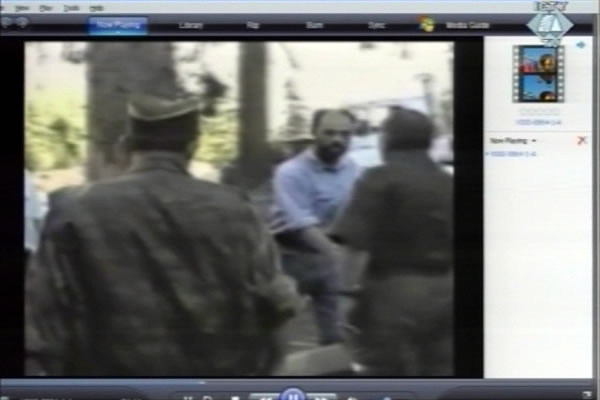 Images from the video filmed during negotiation of the Žepa delegation with Ratko Mladić on the 19. 07. 1995.
 When the witness continued his evidence today, the footage of the negotiations talks between the Zepa delegation and Ratko Mladic on 19 July 1995 was shown in court, revealing the identity of the witness. The witness had said that he and Dr. Benjamin Kulovac took part in the negotiations. The person seen in the footage sitting by the doctor introduced himself as Hamdija Torlak and General Mladic addressed him as such.
Yesterday, the witness described the first round of talks on 13 July 1995; General Zdravko Tolimir demanded that the entire population of Zepa be evacuated. The Zepa war presidency rejected the demand in fear that men of military age would meet the same fate as the men in the Srebrenica enclave, the witness explained.
As the witness recounted, the next day, on 14 July 1995, the Serb forces launched a heavy artillery attack on Zepa. The shelling lasted until 19 July 1995. There was a lull, followed by an invitation to another round of talks – this time with General Ratko Mladic.
The prosecutor today showed a video of the talks between General Mladic and the Zepa defense commander, Avdo Palic. They talked on 19 July, using the radio equipment of the UN Ukraine Battalion. Mladic is trying to talk Palic to attend the talks at a checkpoint manned by the Ukrainians, telling him it was their ‘last chance’ and that refusal to do so would be tantamount to ‘signing your death warrant’.
Doctor Kulovac and Torlak arrived at the Ukrainian check-point on Boksanica instead of Palic. General Mladic told them the entire population should leave the enclave, adding that he would provide the trucks and buses, which would be escorted by the UN vehicles. The witness noted today that parts in which Mladic gave his terms to the BH Army were edited out of the footage of the negotiations filmed by the VRS cameramen. Mladic told the BH Army they had to surrender their weapons and be registered by the Red Cross. After that the BH Army personnel would be exchanged, he said.
When the Zepa War presidency insisted that the men of military age be exchanged on the ‘all for all’ basis, the Serb side took it as their refusal of Mladic’s terms. As a result, the attacks on Zepa resumed on 20 July 1995 with increased ferocity.
The VRS troops came closer to the center of Zepa. On 24 July 1995, when the VRS conquered the ‘key elevation’ for the defense of the enclave – Brezova Ravan – the Serb troops stopped. Mladic called for another round of talks, and this time, the witness went alone. Mladic was very angry, the witness recounted, asking him to sign immediately a paper that was a ‘sort of agreement on the disarmament’. One of the items referred to the evacuation of the population.
He decided to sign that paper as he had no choice, the witness explained. ‘We were forced to do it. I would have signed any paper that meant the people would have to be evacuated, because the inner core of the war presidency had decided to do it,’ the witness said today. He will continue his evidence tomorrow.
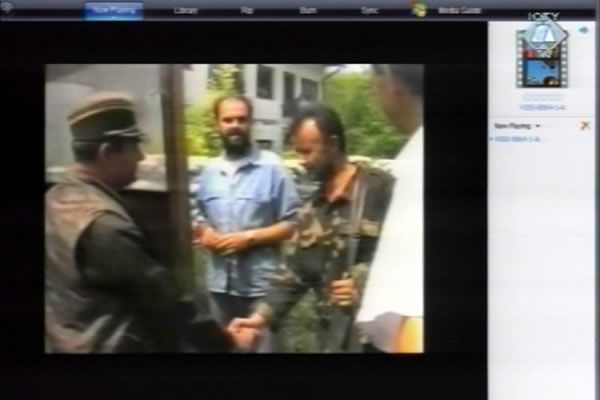 Images of the evacuation of Zepa in july, 1995
 In the footage, the witness was able to identify the site in Zepa from which the buses with the injured, women, children and the elderly departed for Kladanj. He also identified Colonel Avdo Palic, cleric Mehmed Hajric who was the president of the War Presidency, and Amir Imamovic, head of the civil defense. In the last amended indictment against General Tolimir issued in 2009, he is charged with the deaths of these three ‘eminent residents of Zepa’ who went missing after the fall of the enclave.
The last time the witness saw Avdo Palic was on 25 July 1995, at a UN checkpoint in Boksanica. He heard that Palic had been arrested in Zepa upon his return. He had not heard anything about Palic’s fate until ‘a couple of years back’, when Palic’s remains were found near the village of Vragolovi.
The remains of Mehmed Hajric and Amir Imamovic were found at the same site. The two were captured together with the witness on 27 July and detained at a farm in Rogatica. They spent a few days together in the same room of the makeshift prison, but then Imamovic and Hajric were taken away. Their fate remained unknown until their bodies were recovered near Vragolovi.
When Judge Mindua asked the witness why he had been spared, the witness answered in closed session. The witness did speculate in open session that he may have been spared because of ‘some video tapes’, but did not specify the contents or source.
The accused Tolimir is expected to start cross-examining the witness tomorrow. The witness’s name is not mentioned in public in court, as agreed previously by the parties. The witness himself, however, said his own name, both in the footage taken when Zepa fell and in court.
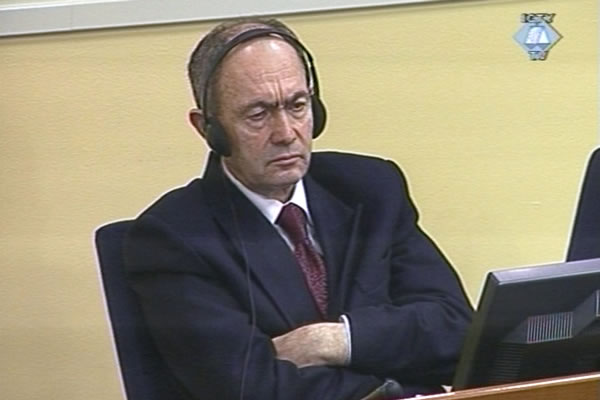 Zdravko Tolimir in the courtroom
 The first reason is that in 1995 – when they received the OTP’s request – the BH authorities had no recordings or transcripts of the intercepted conversations and it follows that it took them three years to fabricate them. The alternative is that the recordings existed but because of their contents it was not in the interest of the BH army and police to hand them over to the Tribunal. In that case, a three-year delay before the material was handed over was used by the State Security Service to ‘make a selection in their labs’ of the recordings and transcripts and delete the unwanted parts.
Stephanie Frease rejected this suggestion, contending those were ‘highly trained persons’ working in the surveillance services of the State Security and the BH Army who had a responsible job, ‘like court reporters’, to write down exactly what they heard. Frease once again said there was no doubt about the authenticity and reliability of the material. ‘Mistakes are always possible but there was no pattern which would indicate there was any kind of selection’, Frease said.
Presiding judge Flugge then asked the witness if she tried to find out why only one side could be heard in some of the recordings. The accused has repeatedly insisted on that point, too. The phenomenon was investigated, Frease said, but she was not able to explain to the Trial Chamber the technical aspects.
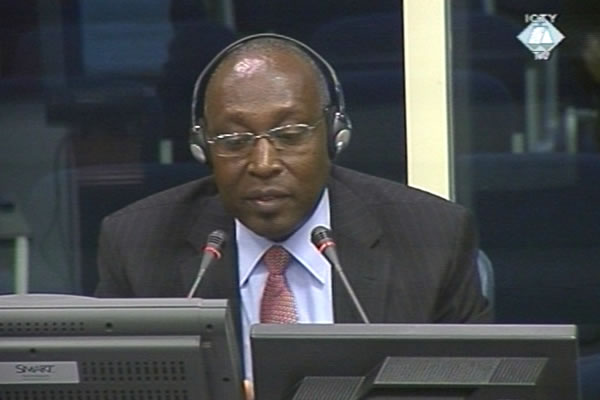 Josef Kingori, witness at the Zdravko Tolimir trial
 According to Kingori, even if the evacuation from Srebrenica had been planned, it couldn’t have been the result of a voluntary decision by the people. Their departure was a necessity, caused by the incessant shelling from the VRS positions. On 11 July, the VRS forces finally entered the town. Kingori also rejected Tolimir’s suggestion that the VRS shelled only military targets. ‘I don’t know of any facilities used by the BH Army except for the communications center in two small rooms located in the post office building’, Kingori said.
Tolimir also tried to contest the witness’s evidence about the threats the VRS officers issued to the Muslim population of Srebrenica through UNPROFOR personnel and UN military observers. Kingori testified that ‘Major Nikolic and Colonel Vukovic’ in their contacts before the attack on Srebrenica repeatedly told him to tell the Muslims that it ‘is best for them to pack and move out or else they will be killed’ because Serbs ‘don’t want to live with the Muslim fundamentalists’.
The accused general suggested that Kingori misinterpreted, because of ‘language barrier’, what the two VRS liaison officers with the UN had said. At the meetings in the Fontana Hotel, General Mladic offered the people of the enclave free choice: to leave or to stay if they laid down their arms.
‘We had no reason not to believe the liaison officers’, responded Kingori. They certainly received their instructions from their superior officers, all the way up to Mladic, since this was their job – to liaise with the UN troops. Also ‘what they told us always came true, including those threats’, the Kenyan colonel stressed. We had no reason to doubt them, Kingori said. Josef Kingori will complete his evidence on Monday.
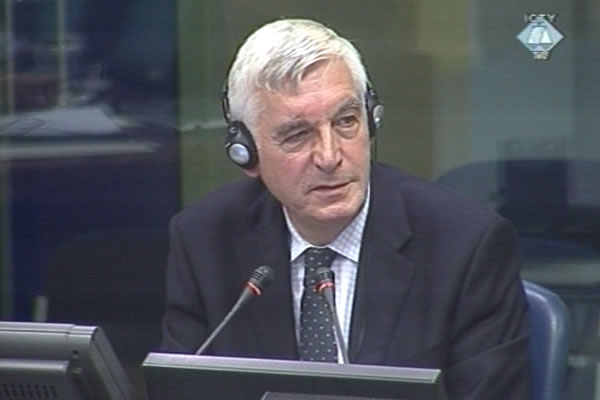 John Clark, witness at the Zdravko Tolimir trial Zdravko Tolimir in the courtroom
 In the summer of 1995, a civilian official in the Bratunac municipality was involved in the effort to ‘take care’ of the people of Srebrenica who had sought shelter near the UN Dutch Battalion base in Potocari following the arrival of Mladic’s forces. Today, he testified under pseudonym PW 063.
At the trial of former assistant commander for security in the VRS Main Staff Zdravko Tolimir who is charged for genocide and other crimes in Srebrenica and Zepa, the witness’s testimony from May 2007 at the trial of the seven RS officers charged with the same crimes was admitted into evidence today. The prosecutor read a summary of the witness’s testimony, which focused on the role of Ljubisa Beara, the security chief in the VRS Main Staff, in the effort to organize the transportation of the men captured after the fall of Srebrenica and their detention.
In response to the prosecutor’s questions, the witness confirmed that on 12 July 1995 he attended a meeting in the Fontana Hotel in Bratunac. As the witness said, General Mladic asked the Bosniak delegation from Srebrenica to state whether they wanted to leave the enclave or to stay. The witness was able to identify the VRS officers and representatives of the Srebrenica’s Muslim population – Ibro Nuhanovic, Camila Omanovic and Nesib Mandzic – on the photos. As the witness said, they stated they wanted to leave the enclave as soon as possible.
General Mladic then ordered the ‘comrades from the municipality’ to provide food, drinks and accommodation to the people gathered in Potocari, the witness recounted. The witness spent two hours in Potocari, monitoring the distribution of bread, water and fruit juice. He claimed he didn’t notice any abuse of refugees. The next day in Bratunac, the witness saw buses full of men. As he recounted, he was told that those men would be taken to the Batkovic prison camp to be exchanged for captured VRS soldiers. Instead of Batkovic, the men were first taken to various locations where they were detained for a short time and were then transferred to execution sites in the broader Srebrenica area.
In the cross-examination, the accused general focused mostly on the crimes against the Serb population in the villages around the Srebrenica enclave after it was declared a protected area in March 1993.
The witness said that contrary to the demilitarization that had been declared, the Serb villages around the enclave were under constant attacks in 1993 and 1994; the buildings were destroyed and the inhabitants expelled or killed. According to the witness, 139 persons, mostly civilians, were killed in two attacks on the village of Bjelovac. On Christmas Day in 1994, 60 persons were killed in the village of Kravica and 25 persons were killed in the village of Fakovici.
The witness said that the attempt of the men from Srebrenica to break through to Tuzla in July 1995 through the woods and hills was caused by their fear of facing the Serb army because they most probably ‘had blood on their hands’ from the attacks on the Serb villages. The witness also corroborated the defense claim that the Bosniaks moving in the column killed each other, because they quarreled over whether to surrender or to continue fighting the Serb forces that encircled them.
In the re-examination, the prosecutor confronted the witness with the fact that a number of detained Muslims were killed in the schools in Bratunac: as a municipal official the witness had to have known about that. The witness was reluctant to answer. The presiding judge then told the witness that he had the right not to answer a question if it could incriminate him. The hearing then continued in closed session. The re-examination of Witness PW 063 continues tomorrow.
 Erin Galagher, witness at the Zdravko Tolimir trial
 At the trial of Mladic’s former assistant for security in the VRS Main Staff Zdravko Tolimir, the prosecution continued showing a compilation of video recordings entitled Srebrenica - Court Video. The footage is a reconstruction of sorts of the events in July 1995 when the crimes the accused general is charged with were committed.
OTP investigator Erin Gallagher was called to testify about the sources of the footage, the way the OTP obtained it and how the compilation was actually put together. Gallagher has been working on the Srebrenica investigation since 2006. Gallagher today continued her evidence, begun a month ago, by describing the footage obtained from the BBC, Reuters and WTN news agencies, from the Serb Radio and Television (today the Republika Srpska Radio and Television) and from Belgrade journalist Zoran Petrovic Pirocanac. The videos show the events is Srebrenica, Potocari and nearby locations on 11, 12 and 13 July 1995.
Today, the court saw video footage showing the gathering of the refugees in Potocari near the UN Dutch Battalion base on 11 July 1995, the arrival of the VRS led by Ratko Mladic in Srebrenica on the same day, the separation of men from women in Potocari, women and children being put on buses in Potocari on 12 July and the attack of the Bosnian Serb army and police on a column of men trying to break through to Tuzla through the woods and mountains.
At the end of her evidence today, the prosecution showed the footage shot by Zoran Petrovic in Potocari, Kravica and Sandici on 13 July 1995. The witness confirmed that the film had been ‘sold to many television networks and TV agencies’. However, as she went on to say, frames edited out from the original recording broadcast in 1995 by a Belgrade TV network, Studio B, were found five years ago.
The frames that were edited out had been recorded in Potocari; they show prisoners on a balcony of a white house. The prosecution alleges that the prisoners were detained there after they were separated from their families. The original footage from the Kravica farm warehouse did not show the bodies of dozens of Muslims piled in front of the warehouse; the indictment alleges that about a thousand prisoners were killed in front of the warehouse. Finally, the footage showing a field near Sandici, also found at a later date, shows the men from the column heading towards Tuzla surrendering to the Bosnian Serb soldiers, and the VRS artillery raining shells on the hills where the column from Srebrenica was trying to get through to the BH Army- controlled territory.
Investigator Gallagher will continue her evidence at a later date.
 Christopher Lawrence, witness at the Zdravko Tolimir trial
 From May to October 1998, Australian pathologist Dr. Christopher Lawrence headed the OTP forensic pathology team that conducted post mortems on the remains of victims exhumed from mass graves in Srebrenica.
In February 2007, Dr. Lawrence testified about this effort at the trial of the seven Bosnian Serb military and police officers later convicted for crimes in Srebrenica and Zepa in 1995. At the trial of Zdravko Tolimir, former security officer in the VRS Main Staff, the prosecution tendered into evidence the transcript of Dr. Lawrence’s testimony at that trial. The prosecutor read out a brief summary from that statement in court.
Dr. Lawrence and his team performed post mortems on the remains of victims exhumed from the Brana mass grave near the village of Petkovci in the Zvornik area, and the remains recovered from seven secondary graves at Cacarski road, the Hodzici road, Liplje and Zeleni Jadar.
The Australian pathologist said that some of the bags in which the remains were brought to the morgue in Visoko contained whole bodies but, more often than not, there were only body parts. This made it more difficult to establish the cause and manner of death.
When Dr. Lawrence was shown photos, he recounted that the determination of the cause of death was made even more difficult by the fact that the bodies were ‘in a very bad shape’. Soft tissue had mostly decomposed and it was hard to distinguish bone defects caused by bullets from those caused later, in most cases when the bodies were moved from primary to secondary graves. Dr. Lawrence concluded that most of persons whose remains he had examined ‘died of gunshot wounds’.
After he examined the bodies of 883 people, Dr Lawrence concluded that in most cases, the victims were not soldiers and that they didn’t die in combat. Based on several factors, Dr. Lawrence determined that they had been executed.
In the cross-examination, General Tolimir insisted that he didn’t want to contest Dr. Lawrence’s report, but wanted Dr. Lawrence to clarify the points Tolimir didn’t understand in the report. He wanted to know how the Australian pathologist was able to tell which of the victims had been soldiers and which non-combatants.
Many of the bodies had ligatures on hands and had been blindfolded; post mortems revealed that many of the victims had been sick and elderly, or women and children. The only logical conclusion was that they couldn’t have been involved in the fighting. The fact that their bodies had been hidden – transferred from primary to secondary graves – also pointed to the conclusion that they had not died in combat, Lawrence noted.
The trial of General Tolimir continues tomorrow.
 Vincentijus Bernardus Egbers, witness at the Zdravko Tolimir trial
 Dutch officer Vincentius Bernardus Egbers began his evidence at the trial of Zdravko Tolimir last Monday. Today, Egbers returned to the courtroom to allow the former general charged with genocide and other crimes in Srebrenica and Zepa in 1995 to continue his cross-examination.
In July 1995, Egbers, who was a lieutenant at the time, commanded a platoon in Bravo Company in the UN Dutch Battalion in Srebrenica. From 8 to 14 July 1995, Egbers witnessed the events described in the indictment against general Tolimir.
On 8 July 1995, the Serb forces opened artillery fire on the observation post manned by Egbers’s platoon, Egbers recounted. Then, on 9 and 10 July 1995, before the Serb troops entered the enclave, the Dutch officer escorted the people from Srebrenica to Potocari. On 13 July 1995, as he was escorting a refugee convoy, Mladic’s troops stopped Egbers in Konjevic Polje and detained him in a local school. Egbers was held there until the next day.
Continuing the cross-examination, the accused general suggested that the Dutch officer had been ‘detained for his own security’. Egbert rejected this claim, noting there were no obstacles that day en route to Potocari – except for the Bosnian Serb forces. Tolimir nevertheless insisted that the BH Army attacks in that area were so fierce that the VRS was compelled to protect the UNPROFOR soldiers, and ‘put them up’ in the school in Konjevic Polje. The Dutch officer remarked ironically that the accused was trying to convince him that he ‘should be grateful to the Bosnian Serb army for protecting me’.
Tolimir also put it to the witness that the Dutch Battalion commander, Colonel Karemans, met with General Mladic on 11 and 12 July 1995 and demanded that the people of Srebrenica be evacuated from that area. Egbers rejected this suggestion, prompting Tolimir to refer to the claims of several witnesses about ‘the people’s explicit wish to leave the enclave’.
‘Those people had no choice’, Egbers replied. ‘Their circumstances, without any food and water, on a hot summer day, without any chance of returning home, forced them to do that. Certainly they did say yes when they were asked if they wanted to leave, but they were forced into that situation’, the Dutch officer concluded.
The trial of Mladic’s assistant for security and intelligence continues tomorrow.
 Tomasz Blaszczyk, witness at the Zdravko Tolimir trial
 The prosecution continues calling evidence at the trial of General Zdravko Tolimir. Investigator Tomasz Blaszczyk gave evidence about the investigation of a video recording made by Zoran Petrovic Pirocanac, journalist from Belgrade in the Srebrenica area on 13 and 14 July 1995. Mladic’s former assistant for security and intelligence in the VRS Main Staff is charged with genocide and other crimes in Srebrenica and Zepa in 1995.
Petrovic’s video, shown at all previous Srebrenica trials before the Tribunal, shows the events in Potocari, on a part of the road leading to Bratunac near the villages of Sandici and Lolici and in the Zeleni Jadar area two days after the Bosnian Serb forces entered Srebrenica and took over the enclave.
In 2006 and 2007, the investigator and an OTP photo and video technician, Zoran Lesic, revisited the sites in the Srebrenica area recorded on the video. The investigator took photos and determined their coordinates using GPS. The locations were then plotted onto the maps of the area and bound in a book together with the photos and freeze frames from Pirocanac’s footage. The prosecution tendered the book into evidence today.
The prosecution first obtained the video in 2002 from the BBC. Later that year, Ljubomir Borovcanin, commander of the police forces in the Srebrenica operation, gave a VHS tape with same footage to the OTP. On 13 and 14 July 1995, Borovcanin acted as the host of the Belgrade journalist when he visited the enclave. Finally, the author himself, Zoran Petrovic Pirocanac, gave the prosecution the uncut footage in 2006, but none of those tapes, as Blaszczyk confirmed today, contained the parts broadcast on 17 July 1995 by Belgrade TV channel Studio B.
One of ‘missing’ parts was recorded in Potocari; Borovcanin drove Pirocanac there in the military vehicle. The Belgrade journalist recorded a group of prisoners on a terrace of the so-called White House. As alleged in the indictment, the men who had been separated from the women were detained there before they were taken to other locations and executed. This part of the footage was missing from the tape Pirocanac had given to the OTP. Instead of the captives in the White House, the tape shows a shell casing.
As the OTP investigator said, Zoran Petrovic explained that some parts of the original video were ‘missing’ because he ‘lacked experience’ working with his camera. As a result, he taped new footage over those parts. When the prosecutor asked if he found the explanation convincing, Blaszczyk replied he finds it hard to believe it: all the taped-over parts, such as the footage from Potocari, contained ‘footage incriminating’ the Bosnian Serb forces involved in the Srebrenica operation.
Tomasz Blaszczyk continues his evidence tomorrow. Erin Gallagher, witness at the Zdravko Tolimir trial
 OTP investigator Erin Gallagher returned to the witness stand at the trial of Zdravko Tolimir, Mladic’s former assistant for security in the VRS Main Staff. Gallagher is testifying about the procedure to identify persons in the videos shown during the prosecution’s case.
Investigator Gallagher, who has been involved in the Srebrenica investigation since 2006, testified in late September 2010 about the way in which the video compilation entitled Srebrenica – court video was made. Apart from saying when and where the videos were recorded, Gallagher also identified locations, persons and items in the footage.
The photos of the Srebrenica refugees in Potocari on 13 July 1995 and in a field near the village of Sandici – where Bosnian Serb forces held the Bosniaks who had been captured or had surrendered – were shown to the family members of the persons reported missing after the enclave fell. The investigator collated the statements of the relatives and friends with other data gathered in the process of identification – such as personal effects, any post mortem reports, DNA samples and the description of the clothes the persons wore when they went missing.
Most of the persons identified in the footage didn’t survive the fall of Srebrenica. Ibro Husenovic was among the few survivors. Gallagher confirmed that Husenovic identified himself in one of the videos. Through the evidence of the OTP investigator, the prosecution tried to provide additional evidence on the credibility and reliability of the video material.
General Tolimir, facing charges of genocide and other crimes in Srebrenica and Zepa, tried to contest the data on the identification of Srebrenica victims. The accused argues that in the identification process, the investigator relied on unreliable forensic findings about persons she was searching for.
Tolimir also contends that many of the names of the survivors from Srebrenica are also on the missing persons list, or at least were on the list for a long time. This served to increase artificially the number of victims, Tolimir maintains. Tolimir tried to corroborate his claim by noting that ‘205 names have recently been deleted from the missing persons list when it was established they were alive’. The investigator replied that although the lists changed as the new data came to light over the past 15 years, it was established that not a single person from the latest list updated in 2009 had survived.
Zdravko Tolimir in the courtroom Former municipal official from Zvornik is testifying under the pseudonym PW-065 at the trial of Zdravko Tolimir; his testimony today is virtually identical to the one he gave in March 2007, again with protective measures, at the trial of the seven Republika Srpska military and police officers. The Trial Chamber found them guilty of the crimes committed in Srebrenica and Zepa. The transcript of witness’ previous testimony was tendered into evidence today at the trial of former Mladic’s assistant for security, who is charged with crimes in Srebrenica and Zepa.
After the solemn oath the presiding judge warned the witness, just as he was warned in March 2007, that he could refuse to answer any questions that might incriminate him. However, as the presiding judge noted, if the Trial Chamber ordered the witness to respond, what he said couldn’t be used against him in court.
In 1995, witness PW-065 was an official in the Zvornik municipality and had frequent contacts with the officers from the VRS Zvornik Brigade. The witness described how in mid-July 1995 – some days after the fall of Srebrenica – he was called to the Zvornik brigade headquarters. An officer was waiting for him in the office and introduced himself as Colonel Ljubisa Beara, chief of security in the Main Staff. The colonel then made a brief speech, saying that ‘a large number of prisoners that are difficult to control and should be got rid of’ were located in the Zvornik area. Beara demanded that the witness and the local authorities assist in the effort. As the witness said, he was surprised to hear an officer from the Main staff say something like that. Soon after the meeting, the witness drove to Montenegro for a holiday.
In his replies to the prosecutor, the witness was reluctant to specify how Beara thought they might ‘get rid of’ the prisoners and what kind of ‘assistance’ he sought from the municipal authorities. After the prosecutor repeated his question, the witness said that he had realized that prisoners would be ‘executed’ and that the municipal authorities were expected to assist with the ‘burial of their bodies’.
In the cross-examination, the accused general put it to the witness that his conclusion was based on assumptions and speculation. As Tolimir put it, the witness reached this conclusion based on the ‘rumors’ about what had happened in the Zvornik municipality after he had left for his holiday. The witness confirmed that he had indeed learned about the events in the Zvornik area only after his return from Montenegro. The witness nevertheless remained adamant about the way in which the Zvornik authorities were supposed to assist the army in the effort to ‘take care’ of the Bosniak detainees that Colonel Beara ‘had got rid of’.
The Trial Chamber sentenced Ljubisa Beara to life and his case is currently under appeal.
 Tanacko Tanić, witness at the Zdravko Tolimir trial
 Tanacko Tanic, former treasurer in the VRS Zvornik Brigade, appeared for the third time as a witness before the Tribunal, this time at the trial of Zdravko Tolimir. The presiding judge warned the witness, who is still a suspect, that he may refuse to answer any questions that might incriminate him. If the judges ordered the witness to respond, his answers could not be used against him in court.
A summary of Tanic’s statement was read out in court today. After the fall of Srebrenica on 14 July 1995, Tanic saw when the Muslims were brought to a school in Orahovac near Zvornik, detained there and then taken to execution sites.
Tanic was there on the orders of his superiors in the logistics company of the Zvornik Brigade. In the schoolyard, Tanic saw two dead bodies and prisoners being put on the trucks. He also saw a pile of bags and personal possessions that was left behind. Tanic claims it was clear to him that those people were not going to be exchanged as they had been told. The indictment alleges that approximately 1,000 Muslims were executed at a site near Orahovac on 14 July 1995. There were children among them. The witness confirmed that a Muslim boy was sat with the driver and two VRS officers in the truck that took Tanic to the barracks that same evening.
The prosecutor asked Tanic why he didn’t inform the Zvornik Brigade commander and other high-ranking officers about what he had seen in Orahovac. Tanic’s answer was that it was not his duty to do so. Tanic saw security chief Drago Nikolic and his deputy Milorad Trbic near the school and he thought they could see for themselves what was going on. Besides, ‘all the executions were carried out in broad daylight and in public and everybody knew about them’, the witness insisted. The people from Serbia could watch the executions in Kozluk, near the Drina river, Tanic said; that day, the executions went on ‘from noon to midnight and everybody knew about them’, he added.
In the cross-examination, General Tolimir put it to the witness that he gave his first statement to the OTP investigators in June 2002 ‘under pressure’. The witness was told that he was being interviewed as a suspect because ‘he was at a crime scene with a rifle’. Tanic denied this, claiming there was no pressure, but he did say he regretted today having given all his statements without a lawyer.
The trial of Mladic’s assistant for security in the VRS Main Staff continues tomorrow.
 Tomasz Blaszczyk, witness at the Zdravko Tolimir trial
 OTP investigator Tomasz Blaszczyk appeared once again at the trial of Zdravko Tolimir as a witness, this time to testify about General Ratko Mladic’s diaries that had been added to the prosecution exhibit list. Blaszczyk testified about the way in which the OTP received this material, about the chain of custody of the diaries from their discovery in Belgrade to their transfer to the Tribunal, and about the authenticity of the seized documents.
As Blaszczyk explained, the Serbian MUP seized the first five notebooks and four video tapes during their search of the apartment used by Mladic’s wife Bosiljka on 4 December 2008. The OTP first received only the scans of the diaries from the Serbian police. On 21 March 2009, the witness received the original notes in Belgrade and brought them to The Hague. Blaszczyk confirmed that he had sole custody of the material from the moment he received the material to the time he handed them over to the evidence unit.
The Serbian police found additional 17 notebooks, audio and video tapes and other documents during their search on 22 and 23 February 2010. The materials were handed over to an OTP official in Belgrade in April 2010. Blaszczyk then took custody of the materials and brought them to The Hague. In both cases the Serbian police inventoried the seized materials. Blaszczyk identified the signatures of Mladic’s wife Bosiljka and son Darko on the inventory lists.
In an attempt to prove the authenticity of the seized diaries, the prosecutor compared video recordings showing Mladic writing down notes at various meetings with the actual notes he took. A video clip shows Mladic meeting with the representatives from Zepa on 13 July 1995 at Boskanica. Mladic’s assistant for security in the Main Staff general Zdravko Tolimir attended the meeting.
The investigator confirmed that the contents of the video material matched the notes taken at the meeting in terms of the date and contents and was able to recognize the notebook Mladic used at the time when the original was shown today in court. The footage shows Mladic writing down notes in that notebook. The authenticity of Mladic’s handwriting was confirmed by a written statement of Mladic’s wartime deputy, General Manojlo Milovanovic, Blaszczyk said. Finally, a table tendered into evidence today, matched the entries from the diaries with other documents corroborating their contents.
General Tolimir wanted to postpone the cross-examination of investigator Blaszczyk because he has been able to go through ‘only parts of this material I consider relevant for the indictment’: Mladic’s notes about the events in Srebrenica and Zepa in the summer of 1995. Tolimir is charged with genocide and other crimes in Srebrenica and Zepa in the summer of 1995.
 Djoko Razdoljac, witness at the Zdravko Tolimir trial
 During the war, Djoko Razdoljac served as the assistant commander for logistics in the VRS Rogatica Brigade. In July 1995, he was in charge of logistics in the Zepa enclave, the other UN protected area that fell to the Bosnian Serbs that month. In his responses to the prosecutor, the witness confirmed that on 19 July 1995 he was there to greet General Mladic at the UNPROFOR checkpoint at Boksanica. General Mladic ordered him to attend ‘on behalf of the Rogatica Brigade’, the negotiations with the representatives of the people from Zepa, Hamdija Torlak and Benjamin Kulovac.
On a video taken at the meeting, the witness was able to identify generals Mladic and Tolimir and Colonel Dudnjik, who commanded the UNPROFOR Ukraine Battalion. Razdoljac’s task during the VRS operation in Zepa was to supply ‘food, clothes and ammunition’ to his brigade and other units involved in the operation. He was also tasked with getting 50-60 buses for the evacuation of the Muslim people from the enclave, and then to take care of the ‘war booty’ and to round up all the livestock that remained in the enclave after its fall.
The witness could not recall the date when the ‘evacuation’ of Zepa ended or the date when the Zepa mosque had been blown up. He did confirm that he saw the ‘lads who had come in to do the job’ by setting anti-tank mines which were then detonated to blow the mosque up. The presiding judge was prompted to warn the witness he could refuse to answer any questions that might incriminate him.
Razdoljac could not recall whether Hamdija Torlak, one of the negotiators from Boksanica, the Zepa priest Mehmed Hajric, war presidency member Amir Imamovic and defense commander Avdo Palic had been detained in the Rogatica prison after the fall of the enclave. He refused to change his evidence even after the prosecutor showed him a report from the security chief in the Rogatica Brigade where the men were listed as ‘prisoners of war’.
According to the prosecution, Colonel Palic was given special treatment. He was assigned a code name, Atlantis, which appears in confidential documents sent to the VRS Main Staff and General Tolimir. The witness claimed he had never heard of the name Atlantis before and that he knew nothing of the whole affair. Only Hamdija Torlak survived the detention in the Rogatica prison. The remains of Avdo Palic, Mehmed Hajric and Amir Imamovic were found near the village of Vragolovi near Rogatica.
In a short cross-examination, the accused general tried to prove that there had been no secret detainees from Zepa and that the VRS did not try to hide the number and treatment of the prisoners of war in the Rogatica prison. The witness confirmed the claims in the documents shown to him by Tolimir, indicating that the International Committee of the Red Cross had been given a list of prisoners of war and allowed access to the Rogatica prison.
General Tolimir’s trial continues tomorrow with the evidence of a new prosecution witness.
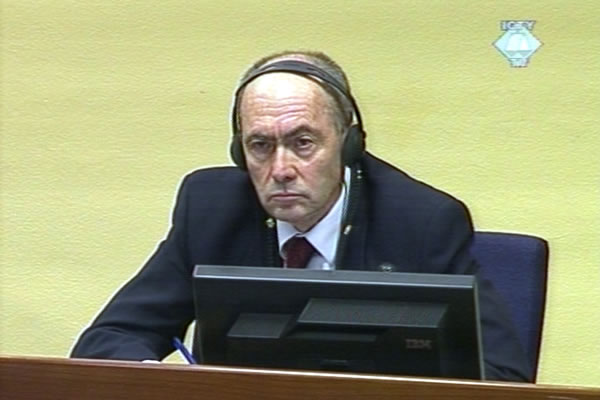 Zdravko Tolimir in the courtroom
 Testifying with image protection but under his full name, former member of the notorious Scorpions unit Slobodan Stojkovic confirmed today that he had taped the execution of six Bosniak boys and youths in Trnovo in July 1995. The video of the execution was first shown at the trial of Slobodan Milosevic on 1 June 2005.
Stojkovic was a member of the unit from 1992 and was in charge of logistics. In July 1995, the unit was sent to Trnovo to help defend the line held by the Bosnian Serb forces. Apart from taking care of supplies and preparing food in Trnovo, the witness was given task to record various event ‘in his free time’ with a video camera. The witness got the video camera from Dusan Kosanovic, who preceded him as a ‘cameraman’ in the unit.
As the witness said, the unit commander Slobodan Medic Boca ordered him to record the execution of six prisoners. In the recording, replayed again in the courtroom, Stojkovic identified members of the unit who took part in the execution. The witness claimed he ‘didn’t believe’ the captured youths were from Srebrenica and that they would be executed. He assumed they would be exchanged.
The prosecutor brought up records and statements made by the accused members of the Scorpions at the trial before the Special War Crimes Court in Belgrade in 2007. The documents state that VRS officers were also seen at the crime scene. Stojkovic denied this, claiming that only the Scorpions were there in the abandoned weekend houses near Trnovo where prisoners were executed.
Stojkovic claimed he didn’t know if the Scorpions were under the VRS control in the Trnovo area, adding that he didn’t know if the unit commander, Slobodan Medic, met on Mount Jahorina with somebody from the Republika Srpska military leadership. The unit stopped there en route to Trnovo to get food and ammunition.
The accused general didn’t have any questions for this witness. Tolimir said that the defense was happy with what a Belgrade court found about Stojkovic’s video in its judgment, which was admitted into evidence.
The judges finally asked the witness to clarify what happened with his video tape after the unit returned to the headquarters in Djeletovci. As Stojkovic explained, on the orders of the commander he gave the tape to Dusan Kosanovic. Later Stojkovic heard that the tape was copied and copies were given as ‘souvenirs’ to the Scorpions members who took part in the execution. The witness learned that one copy even ended up in a local video rental shop in Sid where it could be rented.
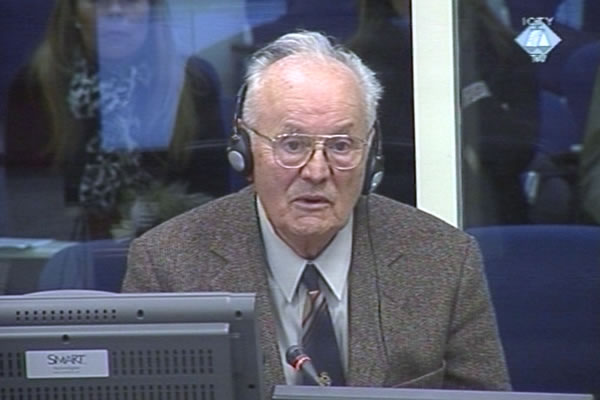 Jugoslav Gavrić, witness at the Zdravko Tolimir trial
 Doctor Jugoslav Gavric, retired director of the medical center in Zvornik, transferred a group of wounded Muslim prisoners from the health center in Milici to the hospital in Zvornik in mid July 1995 on the orders of the VRS medical service chief in the VRS, Ratko Rokvic. In March 2007, Gavric testified about that at the trial of seven Bosnian Serb military and police officers charged with crimes in Srebrenica and Zepa. Today, the transcript of Gavric’s testimony was tendered into evidence at the trial of General Zdravko Tolimir, who is charged with genocide and other crimes in Srebrenica and Zepa in 1995.
The prosecutor read out the summary of the witness’s evidence. After he received a written order signed by Dr. Davidovic, chief of the Military Medical Center, Dr. Gavric brought a ‘group of 10 to 15 wounded persons’ escorted by a soldier and a nurse to the Zvornik Hospital. Some of them had serious abdominal wounds. The witness recounted that those patients had been given first aid in the health center in Milici. Their medical records were put together there, and Dr. Gavric received them.
Some of the wounded prisoners were critical and the next morning, as soon as he got to work, Dr. Gavric asked if all of them had survived the night. The witness claims he was told that all of them were alive and that they had been transferred to Tuzla for further medical treatment. As the prosecution alleges, eleven prisoners were taken from the hospital in Zvornik to the military infirmary in the Zvornik Brigade barracks in Karakaj where they were executed soon afterwards.
As he answered prosecutor Hasan’s questions, Dr. Gavric couldn’t specify how the patients’ injuries had been inflicted. As he explained, because of the protests by the local Serbs and some other patients, he had ordered the wounded men to be segregated from the other patients in the hospital.
The summary of his testimony in 2007 indicated that the wounded were Muslims. However, in his responses to the judges, Dr. Gavric said that in July 1995 he didn’t know that because he ‘didn’t pay attention to their names’ in the documents he had received. According to Dr. Gavric, he didn’t know that the wounded Muslims were transferred to the military infirmary in the Zvornik Brigade. The witness took it for granted that they were taken to Tuzla. ‘We didn’t communicate much with Tuzla at the time and I couldn’t get any information from there’, the witness explained.
General Tolimir, who represents himself, didn’t have any questions for Dr. Gavric. The judges rejected the prosecution’s request for re-examination, deciding that the discrepancies between the witness’s evidence in 2007 and today did not call for his impeachment, which had been the prosecution’s intention.
The trial of Zdravko Tolimir continues on Monday with the evidence of another prosecution witness.
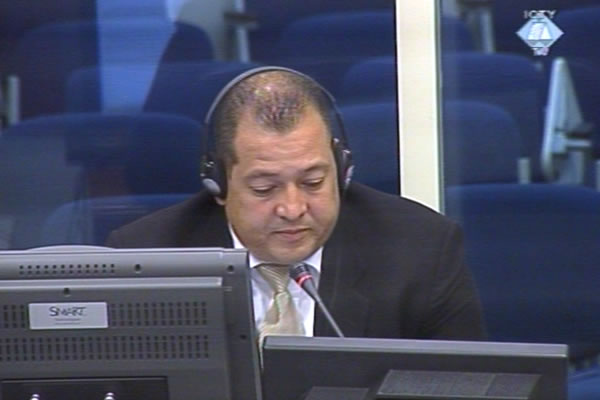 Fredi Peccerelli, witness at the Zdravko Tolimir trial
 About 1,000 Muslims were executed on 14 July 1995 at the execution site near Orahovac, alleges the indictment against General Zdravko Tolimir, Mladic’s assistant for security in the VRS Main Staff. The Muslims were captured after the fall of the Srebrenica enclave. Their bodies were buried in mass graves dug by the military engineering unit of the Zvornik brigade near the execution site, the indictment alleges.
Excavation work has been done in the area three times since that time, according to forensic anthropologist from Guatemala Fredi Peccerelli, who is testifying at Tolimir’s trial. In 2000, Peccerelli was in charge of the exhumations of the mass graves at Lazeta 1 and Lazeta 2 sites.
From July 1995 to August 2000, excavations were carried out in the Lazeta area twice more. First, in September 1995, some bodies were removed from the mass graves to be buried in the so-called secondary graves in a secret operation the VRS had launched that fall to eliminate all evidence of their crimes. After that, in 1996, the Tribunal’s prosecution asked a forensic team from the organization Physicians for Human Rights to start exhuming the bodies at the Lazeta 2 site. The forensic experts dug two trenches, found some bodies and stopped their work. As far as Peccerelli could recall, they did it for ‘security reasons’.
Today the prosecutor tendered into evidence Peccerelli’s expert report on the exhumations at Lazeta 1 and Lazeta 2 sites in the summer of 2000. The remains of 127 persons were recovered from the mass grave at the first site, and two more bodies were found in a nearby trench. About 89 cloth blindfolds were recovered from the grave and more than 450 7.62mm rifle casings were collected on the surface. Some wristwatches were found and there were personal documents on three bodies.
At the second location, which was, according to the witness, ‘dug up without authorization’ in the fall of 1995, the Physicians for Human Rights team dug out two trenches in 1996. In August 2000, forensic experts found another 16 complete bodies and 26 body parts. Blindfolds were also found, made of the same cloth as those recovered from the Lazeta 1 grave. A total of 671 rifle casings were collected from the surface.
In the cross-examination, the accused asked the Guatemalan anthropologist to explain the difference between ‘complete and incomplete bodies and body parts’ recovered from mass graves. The accused also asked the witness to what extent the DNA identification depended on the degree of kinship between the victim and the person who provided the sample. He wanted to know if it was possible to identify a person based on a single recovered bone and what could be established from a watch found in a mass grave.
After Peccerelli, the prosecutor called Mitar Lazarevic to the witness stand. Lazarevic, former assistant commander in the Second Battalion of the VRS Zvornik Brigade, continues his evidence tomorrow.
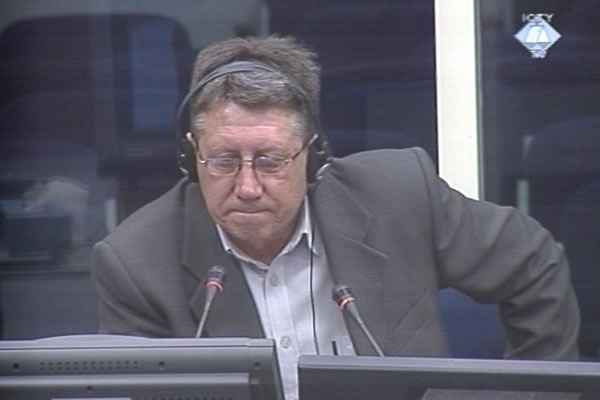 Lazar Ristic, witness at the Tolimir trial
 Prosecution witness Lazar Ristic served as the deputy commander in the 4th Battalion, Zvornik Brigade, in the summer of 1995. Before that, he was the security officer in the same unit. Today he agreed with Zdravko Tolimir that security officers in the VRS units, in line with the service manual, ‘did not have the right to issue orders’. As Ristic recounted, as a security officer in a battalion, he could merely ‘propose to the commander measures to be taken’, but not issue any order to anyone. The instructions to arrest deserters, for instance, did not have the force of orders, and were not binding for the military police.
Apart from trying to deny the existence of a parallel chain of command, in the security sector, Tolimir tried to prove in his cross-examination that the executions of Muslims captured after the fall of Srebrenica was not pre-planned. Ristic claimed he had reached the same conclusion after he discussed the execution in Orahovac with former Zvornik Brigade security officer, Drago Nikolic. As Ristic said, Nikolic told him on that occasion that on 14 July 1995 he was ‘taken aback and surprised’ by the decision to move the prisoners to the Zvornik area. Believing that the prisoners would be exchanged, he put them up in the school in Orahovac, because it was close to the demarcation line. The accused and the witness agreed that the decision to exchange the prisoners was ‘obviously altered at a later stage’.
When the accused tried to prove the Bosnian Serbs did not intend to execute the men captured after the fall of Srebrenica, the prosecutor addressed the issue in Ristic’s re-examination. He showed Ristic the statement of the facts signed in May 2003 by the former Zvornik Brigade chief of staff, Dragan Obrenovic, which is part of his plea agreement. In the statement, Obrenovic says that Nikolic told him on 13 July 1995 that the prisoners were brought to the Zvornik area. Nikolic said they were brought in ‘to be executed’.
Ristic confirmed he had read Obrenovic’s statement but maintained that ‘decision to exchange prisoners was altered subsequently’. If the intention had been to execute them, the witness contends, they would have been shot in Konjevic Polje, where they were either captured or surrendered. The prosecutor then put it to the witness it was impossible because there were still some people from the international organizations in the Konjevic Polje, and the captives could not be executed in their presence. Ristic said he had no knowledge of the events outside of the area of responsibility of the 4th Battalion; he was adamant that the prisoners were not to be brought to Orahovac.
The trial continues tomorrow with a new prosecution witness.
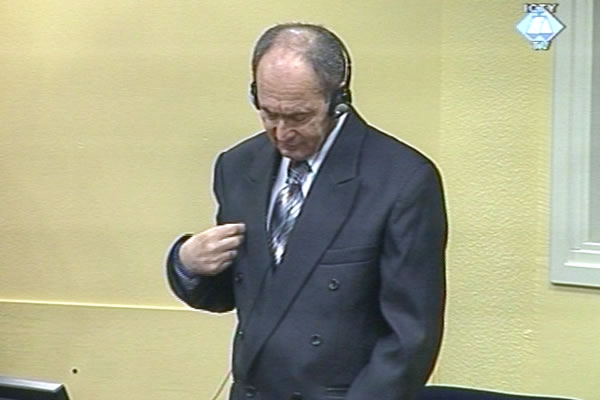 Zdravko Tolimir in the courtroom
 The prosecution at the trial of Zdravko Tolimir called a witness who testified under the pseudonym PW-016. On 16 July 1995, the witness survived an execution at the Branjevo farm. According to the indictment, more than 1,000 Muslims captured after the fall of Srebrenica were executed there. The witness’s evidence from the trial of General Radislav Krstic was tendered into evidence and the prosecutor read the summary of the statement.
After the arrival of Mladic’s troops in Srebrenica, the witness joined the long column of soldiers and civilians heading toward Tuzla through the woods. When the Serb soldiers ambushed the part of the column where the witness was, the witness was captured and detained in the school in Nova Kasaba. From there, he was transferred to a football field half-filled with prisoners, who were lined up. General Mladic came soon afterwards, and promised to the prisoners that they would be taken to ‘Bratunac for lunch and then to Batkovic where they will be exchanged’.
The captured Muslims were taken to Bratunac but instead of having lunch, they were awake all night, without any food or water. The next day they were taken to a school in the village of Pilica near Zvornik. Two days later, on 16 July 1995, the witness, with his hands tied behind his back, was brought before an execution squad at the Branjevo farm. The bullet only grazed the witness’s back but he fell down and lay among the dead until the next day. Together with another survivor the witness tried to find a way to the liberated territory. Exhausted, the witness finally surrendered to the Serb forces and was taken to the Batkovic prison camp near Bijeljina, where he was detained until 26 December 1996, when he was exchanged.
In the cross-examination, the witness confirmed to the accused general that he had served in the BH Army 28th Division, claiming he had not been armed. Tolimir put it to the witness that ‘General Mladic’s promises’ came true in his case: he eventually arrived in Batkovic, although with a delay, and was exchanged there. ‘Yes, after he executed 10,000 persons’, the witness commented, adding that the reason why he was able to reach Batkovic was because he escaped from the execution site.
The accused intended to corroborate his argument that the ‘initial decision of the supreme commander’ to exchange prisoners from Srebrenica was ‘later changed’ and the prisoners were executed. When Tolimir asked the witness if there was a possibility that the decision had been changed, the witness couldn’t say.
The trial continues on Monday with the evidence of Mile Simanic. In the summer of 1995, Simanic was deputy commander in the 5th Engineers Battalion of the VRS Drina Corps.
Zdravko Tolimir in the courtroom On 14 July 1995, the 5th Engineers Battalion of the VRS Drina Corps informed the command that its soldiers ‘in cooperation with the MUP forces successfully engaged the enemy’ and that ‘1,000 to 1,500 enemy soldiers and civilians were arrested killed’. According to the indictment against General Zdravko Tolimir, more than 1,000 Muslims captured after the fall of Srebrenica were killed on 13 July 1995 near Konjevic polje, in a warehouse at a farm in Kravica.
The combat report for 14 July 1995 was signed by deputy battalion commander Mile Simanic, who was called as a witness at the trial of Mladic’s assistant for security in the VRS Main Staff. In July 1995, Simanic’s battalion guarded the barracks and the ammunition depot in Konjevic polje. There were too few soldiers – only about 20 – and the barracks were further secured by mine fields laid on two sides. Simanic claims that his unit had no combat tasks except ‘guarding the barracks’. The prosecutor then showed the witness a document describing successful combat activities of the battalion troops and asked him if he had signed the document.
Simanic recognized his signature but didn’t remember signing the combat report. The witness explained that he often signed blank documents that were later filled in with text or simply didn’t bother to read them before signing. Commander Andjelkovic was usually in charge of administrative tasks in the battalion, Simanic explained. As Andjelkovic was away at the time, Simanic filled in for him. According to Simanic, the information about a large number of ‘enemy civilians and soldiers who were arrested killed’ came to the battalion headquarters from the soldiers who came back from their regular leave. The fact that two soldiers from the battalion were injured on 13 July 1995 while on guard duty in the barracks in Konjevic polje showed, according to Simanic, that ‘something was going on’.
Simanic claimed that he didn’t write or read the report and didn’t remember signing it. He noted nevertheless that the superior command should have been notified about the events so that it could check them, since the battalion ‘didn’t have intelligence officers who could do it’.
The accused general is representing himself in his trial. In the cross-examination, Tolimir showed the witness some reports the Drina Corps sent to the VRS Main Staff on 14 and 15 July 1995. The reports make no mention of ‘the enemy soldiers and civilians who were arrested killed’ that the combat report from Simanic’s battalion speaks about. The witness agreed with the accused general that the Corps command concluded after checking the information that it was not worth being included in a report to be sent to the VRS Main Staff.
General Zdravko Tolimir’s trial continues tomorrow.
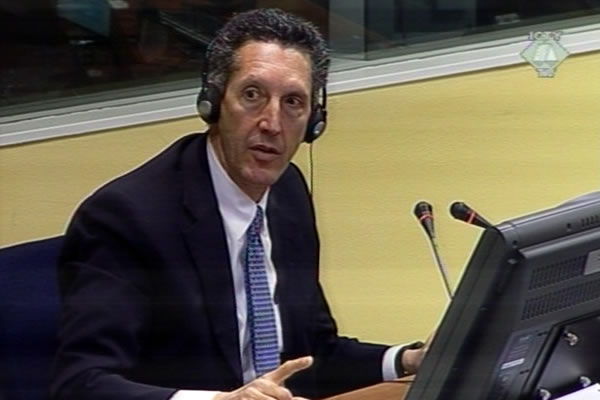 Edward Joseph, witness at the Zdravko Tolimir trial
 Edward Joseph is testifying for the prosecution at the trial of Zdravko Tolimir. In July 1995, Joseph was in Zepa as an UNPROFOR civil affairs officer. Zepa, a protected area, came under attack by Mladic’s troops after they took Srebrenica. Joseph’s colleague in Zepa was Ukrainian Viktor Bezruchenko. In August 2007, Joseph testified about his mission in Zepa at the trial of the seven Bosnian Serb military and police officers charged with the crimes in Srebrenica. The transcript of the testimony was admitted into evidence today at the trial of Mladic’s former assistant for security in the VRS Main Staff. Tolimir is charged with genocide and other crimes in Srebrenica and Zepa.
Joseph’s superior was David Harland, chief of the UN civil affairs in BH. Harland reported on the situation in Zepa to the senior civil affairs officer. After the prosecutor showed the witness a series of Harland’s reports, the witness confirmed that he and Bezruchenko were the sources for some of the information contained in the reports.
Joseph also confirmed that he had contributed to some of Harland’s assessments in the reports. For example, before Mladic’s troops entered Zepa, the witness thought ‘the Serbs will not launch an infantry attack on the enclave before they exhaust it completely’. Joseph explained what he meant when he used the word ‘exhaust’: to isolate the enclave, to cause shortages, and to shell non-military targets.
One of Harland’s reports speaks about a plan for the ‘evacuation’ of people from Zepa. The prosecutor asked why the word ‘evacuation’ was in quotation marks. The procedure was more akin to ‘a forcible expulsion’ than an evacuation ‘of the kind you’d see following a natural disaster’, the witness replied. Judge Niamba asked the witness if a proper evacuation as he’d described it was possible at all in a war. Joseph maintained it was, supporting his claim with the recent evacuations from Libya caused by the clashes between the government forces and the anti-government protesters.
At the beginning of the cross-examination, General Tolimir remarked that in his evidence Joseph presented a ‘series of assumptions’ because the prosecutor asked him some hypothetical questions. Tolimir, who represents himself, will continue cross-examining Joseph tomorrow.
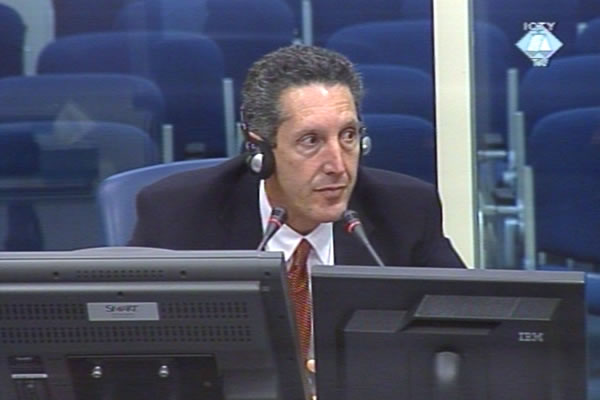 Edward Joseph, witness at the Zdravko Tolimir trial
 In his cross-examination of prosecution witness Edward Joseph, the accused Zdravko Tolimir contended that Bosniaks in fact thwarted the agreement on the voluntary surrender of soldiers and the evacuation of the people from Zepa in July 1995.
The agreement that was reached, according to Tolimir, between ‘the legitimate representatives’ of Bosniaks on the one hand, and himself and General Mladic on the other hand on 19 July 1995 collapsed because of an attack launched by the BH Army the next day on the UNPROFOR Ukrainian Battalion. The BH Army was able to seize substantial quantities of weapons and military equipment.
The witness could neither confirm nor deny the claims of the accused that the Bosniaks attacked UNPROFOR. As he explained, he was not in a position to determine to what extent that attack affected the fate of an agreement. Every attack on UNPROFOR, launched by any of the sides, represented a violation of the basic agreement on the establishment of protected zones, Joseph added.
In the re-examination, prosecutor Nelson Thayer revisited the issue, showing the witness his report on the situation in Zepa of 19 July 1995. In the report, Joseph said that the ‘VRS continued shelling the protected zone and the civilian population there’. The witness confirmed he received the information from the Ukrainian blue helmets in the field and that he himself heard the shelling when he was at the UNPROFOR check point in Boksanica.
At the end of his testimony, the witness was asked if the removal of the population from the enclave (Joseph had called it ‘forcible expulsion’) was a collateral consequence of the VRS military action. Joseph replied it wasn’t. ‘That was the objective of the military action: to eliminate the military threat and to remove the civilian population’, the witness concluded.
After Joseph completed his evidence, protected witness PW 018 took the stand at the Tolimir trial. In July 1995, the witness survived an execution near the village of Nezuk. The witness had been captured while trying to get through to the territory under the BH Army control.
Zdravko Tolimir in the courtroom Protected witness PW 018 left Srebrenica on 11 July 1995, just before Mladic’s troops entered the town. The next day the witness headed out from the village of Susnjari in a column of civilians and soldiers towards Tuzla, which was controlled by the BH Army. The witness had already testified at the Radislav Krstic trial about his ordeal that lasted until 20 July 1995, when he finally reached the liberated territory. The transcript of the testimony the witness gave in 2000 was admitted into evidence today at the trial of Zdravko Tolimir. The prosecutor asked the witness some additional questions.
As the column tried to break through to Tuzla, the witness managed to survive a number of ambushes and to pass through some mine fields where hundreds of people in the column were killed. On 19 July 1995, the witness reached the area of Baljkovica and Nezuk. There Bosnian Serb soldiers in camouflage uniforms captured the witness. He remembers only that the soldiers wore the insignia with the words ‘Krajina...’ and ‘Drina...’.
The witness was taken out to be executed together with nine other prisoners, including a relative of the witness and a 15-year old boy. The soldiers brought the prisoners out one by one and then fired a single shot in the back. A bullet hit the witness in the left shoulder: he fell and lay there until dark, pretending he was dead. After the soldiers left, the witness ran into the forest. The next day, the witness managed to get through to the BH Army-controlled territory.
General Tolimir spent most of his cross-examination focusing on issues related to the formation, organization and coordination of the movement of the column that was trying to reach Tuzla. The witness and other civilians and soldiers were in the column.
The witness dismissed Tolimir’s suggestions that the forming of the column was in fact tantamount to the 28th Division organizing an effort to fight its way through the VRS defense lines; it was merely an attempt to retreat towards the liberated territory. The witness disagreed with Tolimir’s claim that when civilians joined the column they became legitimate military targets and that they were thus exposed to additional dangers. ‘Here we are talking about people trying to save their lives, to stay alive’, the witness said.
In an effort to prove his argument, Tolimir referred to a statement made by Ramiz Becirevic in August 1995, where the former chief of staff of the BH Army 28th Division describes the ‘timeline of the breakthrough’. The witness noted he didn’t know Becirevic, adding that he couldn’t comment on Becirevic’s statement about the structure of the BH Army units because he himself served in the Srebrenica Territorial Defense until March 1993, and had nothing to do with the army in any way after that time.
The trial continued with the evidence of handwriting expert Kathryn Barr, set to continue tomorrow.
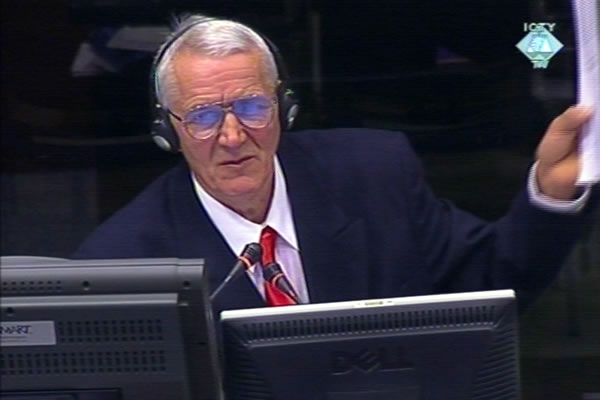 Nedjeljko Prstojevic, witness at the Radovan Karadzic trial
 Continuing the examination of Nedeljko Prstojevic, former president of the Crisis Staff in the Serb municipality of Ilidza, the prosecutor put it to the witness he was a ‘leading admirer and supporter’ of Radovan Karadzic. According to the prosecutor, the witness is trying to protect the former Republika Srpska president by making a large number of corrections to the evidence he gave in 2005 at the trial of Momcilo Krajisnik.
Prstojevic labeled such prosecutor’s claims ‘weird’, because he was, as he said, ‘a man who obeys law’ who supported the Serb leadership when it acted fairly and lawfully, but opposed the decisions he thought were not feasible. Prosecutor Alan Tieger then quoted from an article published in the British newspaper London Observer. According to the article, at an election rally in Dobrinja in September 1996, the witness addressed a crowd of about 3,000 Serbs, praising Karadzic calling him ‘a legend’ and ‘the greatest Serb among us’, comparing him with Orthodox saints.
‘I don’t remember this at all’, Prstojevic replied. During the examination, the prosecutor often had to refresh Prstojevic’s memory by quoting from his evidence at the Krajisnik trial. Bringing up a document known as ‘Variants A and B’, the prosecutor tried to show that the Ilidza municipal authorities acted under the instructions issued by the SDS Main Board on 19 December 1991. In 2008, in his evidence in Krajisnik’s defense, Karadzic claimed that the instructions represented ‘an expert opinion of some frightened retired officers’ and that the SDS Main Board merely ‘circulated’ it.
In the Ilidza municipality, the instructions were implemented ‘partially’ and ‘formally’, Prstojevic said. When the Crisis Staff and the Assembly of the Serb Municipality of Ilidza were established in early 1992, an ‘end was put to’ the instructions. As he objected to the prosecutor’s questions, Karadzic several times all but put answers into the witness’s mouth. This prompted the judges to caution Karadzic.
Last Thursday, at the beginning of his evidence, Prstojevic said that he suffered a ‘mild brain hemorrhage in 1996’: as a consequence, he has problems remembering things. Prstojevic added that sometimes he ‘thinks one thing and says something else’. As for some glaring discrepancies between what he said in the Krajisnik case and what he claimed today, he claimed those were caused mostly by bad translations into English and incomplete transcripts of intercepted conversations, where some sentences end with three dots.
According to Prstojevic, at the 17th session of the Serb assembly he didn’t speak about ‘expelling’ Muslims from Ilidza as his words were interpreted at the Krajisnik trial. Rather, Prstojevic claims, he spoke about ‘pushing them back’, which is a military term used for the ‘enemy personnel’ and not civilians. In his speech before the Assembly, Prstojevic actually referred to a meeting on 18 April 1992 when Karadzic, Momcilo Krajisnik and members of the Serb government came to Ilidza. According to the prosecutor, the meeting dealt with the military and security situation. Prstojevic claims that this topic was only glossed over while the discussion focused on the future seat of the Serb government.
 David Wood, witness at the Zdravko Tolimir trial
 British officer David Wood, now retired, is testifying for the prosecution at the trial of Zdravko Tolimir. In July 1995, he was a close associate of General Rupert Smith, the commander of the UN troops in BH. Lieutenant colonel Wood, who was a major at the time, commanded a unit of the Joint Monitoring Commission in the UNPROFOR command in Sarajevo.
As a member of General Smith’s team, the witness accompanied the UN commander at almost all the meetings about the crisis in Zepa, the second UN-protected enclave taken by the VRS after Srebrenica. The witness met high-ranking Bosnian Serb officers on many occasions. Generals Mladic and Tolimir stood out in Wood’s memory because he saw them very frequently in the second half of July 1995.
The witness was introduced to Tolimir in 1995 in Pale at a lunch for the UN delegation after their meeting with Radovan Karadzic. Tolimir made it clear that he knew what Wood did, remarking that the two of them ‘are in the same job’. Tolimir also showed him a small bag attached to his belt. A hand grenade was inside, the witness recounted, and Tolimir explained to him that he ‘will never be caught’ because he would kill himself with the grenade.
The British officer also described his encounter with Tolimir in Zepa on 25 July 1995. There the witness who was ‘the sole UNPROFOR representative at the scene’, observed the women, children and elderly being put on buses and driven out of the enclave. According to the witness, Tolimir coordinated the operation and was assisted by several soldiers and police officers. In about 30 minutes the witness spent there, there was no overt violence. However, Wood claims he felt as if he witnessed a ‘scene from the Holocaust’. Tolimir held a pistol at shoulder height, contributing to the atmosphere of fear among ‘the people who were already scared’ and everything looked like ‘an instance of non-violent ethnic cleansing’, Wood said.
In the cross-examination, Tolimir used the testimony of the previous witness, UNPROFOR civil affairs officer Edward Joseph to contest the evidence of the British lieutenant colonel. Joseph recounted that he too observed the people board buses in the center of Zepa and assisted them. The accused asked the witness to look at a video recording showing the civilians and Mehmet Hajric, president of the Zepa War Presidency, and Avdo Palic, who commanded the BH Army unit in the enclave. Palic and Tolimir are seen shaking hands in the video. Lieutenant colonel Wood nevertheless remained adamant that in the half hour he spent in Zepa on the afternoon of 25 July 1995 he didn’t see those persons or anyone from UNPROFOR.
Judge Niamba asked the witness what he, as an UNPROFOR officer, could or should have done in the situation he described. The British officer replied that he didn’t respond because there was no direct violence. The witness thought that his presence at the time was enough to deter violence.
The trial of General Tolimir for genocide and other crimes in Srebrenica and Zepa continues on Monday.
Zdravko Tolimir in the courtroom A former Serb police officer from Bijeljina testified today at the Zdravko Tolimir trial under the pseudonym PW 054 and with image and voice distortion to protect his identity. He testified for the most part in closed session. In the examination-in chief, the public heard only that the transcript of the witness’s testimony at the trial of seven Bosnian Serb military and police officers in 2006 had been admitted into evidence. The seven Bosnian Serb military and police officers faced the same charges as Tolimir: genocide and other crimes in Srebrenica and Zepa in 1995. Even the brief summary of the witness’s statement, as a rule meant to be made public, was read out in closed session.
In a mop-up operation in the Zvornik area in the second half of July 1995, a group of Bosniaks surrendered to the witness’s unit. After the fall of Srebrenica, the Bosniaks were trying to reach Tuzla through the woods. Among them was a 16-year old youth whom the witness saved by hiding him in a safe place before the other prisoners were executed. This is more or less all that could be learned in the brief parts of the hearing that were open to the public.
In the cross-examination, the accused general referred to the witness’s statement that his superior officer had ordered him not to allow any of the civilians and soldiers in the column moving from Srebrenica through the territory covered by the witness’s unit. ‘Not even a fly shall pass through’, Tolimir repeatedly quoted the words of the witness’s commander. Tolimir put it to the witness that the purpose of the instruction was to stop further advance of the column towards Serb positions and not to kill all the men from the column who fell into the Serb soldiers’ hands. The witness remained adamant that his understanding of the order was for his unit to kill everybody they encountered.
The trial of Mladic’s former assistant for security in the VRS Main Staff continues tomorrow with another prosecution witness.
 Rupert Smith, witness at the Zdravko Tolimir trial
 ‘General Gvero played second fiddle to General Tolimi r who was in turn described by Mladic as his right hand man’, British general Rupert Smith said in a statement he gave the OTP investigators in 1996.
Testifying at the trial of General Zdravko Tolimir charged with genocide and other crimes in Srebrenica and Zepa in July 1995, General Smith explained what this impression was based on. Mladic himself described Tolimir as his ‘right hand man’ – Smith would not have put that in quotation marks in his statement otherwise. The impression that Tolimir was ‘Mladic’s trusted and close associate’ was based on a number of meetings Smith had in 1995 as UNPROFOR commander in BH with Mladic, commander of the VRS Main Staff; Tolimir often attended those meetings. From their relationship, body language and their tone of voice, Smith was able to conclude they talked ‘as equals’ and that they ‘worked together, not in a strict hierarchical relationship’.
In late July 1995, Smith negotiated the evacuation of the civilians from Zepa with Mladic’s right hand man. Smith concluded that Tolimir was personally in charge of the cleansing of the enclave. Tolimir had to find the buses and oversee the boarding of the civilians. According to Smith, Tolimir played the same role earlier that month in Srebrenica, although Smith could not say whether Tolimir was physically present in Srebrenica. He remained adamant even when the prosecutor told him Tolimir had not been in Srebrenica.In light of Tolimir’s function as Mladic’s assistant for security and intelligence, a key element in the command process, according to Smith, everything that happened after the fall of Srebrenica was within Tolimir’s purview.
Before General Smith started his evidence, the transcript of the testimony he gave in 2003 at the trial of the seven Bosnian Serb military and police officers charged with the crimes in Srebrenica was admitted into evidence. Among them were three security officers: from the VRS Main Staff, the Drina Corps and the Zvornik Brigade; all three were Tolimir’s subordinates. The three received the harshest punishment: Beara and Popovic were sentenced to life and Nikolic to 35 years in prison.
Smith briefly recapped his statements and repeated some of the claims he made recently at the Radovan Karadzic trial. He described how in early 1995 the warring factions began their preparations for a military solution to the conflict in order to win the war by the end of the year. The BH Army built up its strength and bought more weapons, while the Republika Srpska Army was getting ready to tighten the noose around the enclaves in Srebrenica and Zepa in order to be able to control them better and to free up some of the forces tied up there and commit them to other active fronts. The intent to tighten the noose around the UN protected enclaves was apparent from the Bosnian Serb strategy of preventing supply convoys from entering the enclave. This not only served to exhaust the population, but to weaken the strength of the enemy troops and the peace-keepers to resist the final VRS offensive.
In this situation, both sides tried to use UNPROFOR for their own ends, General Smith said. The Bosnian Serbs tried to use it as ‘hostage’ to exert pressure on the international community, and the BH Army as its ‘shield’, turning the peace-keepers effectively into their allies, and to provoke the outside intervention.
General Tolimir will have, as indicated, four full days to cross-examine General Smith.
 Rupert Smith, witness at the Zdravko Tolimir trial
 The people in the Zepa protected area were evacuated in late July 1995 in line with an agreement reached by ‘all three sides’: the BH government, the VRS and UNPROFOR and all three sides took part in it, claimed the accused Zdravko Tolimir, Mladic’s former assistant for security, as he cross-examined General Rupert Smith, who commanded the UN troops in BH at the time.
Despite ‘the joint agreement’ and the fact that everyone took part in the evacuation, only one side – the Serb side – is blamed for the expulsion of the civilian population of Zepa, Tolimir said. He corroborated his claim about ‘a consensual evacuation’ with the correspondence between Alija Izetbegovic and the war presidency of Zepa which states that General Smith ‘guarantees the safety of the evacuation of women, children and the elderly from the enclave’.
Izetbegovic expressed great concern for the civilians, Smith said, but was unable to recount any details from his conversation with Izetbegovic on 18 July 1995. Smith couldn’t remember if he ‘used the term guarantee’ when they spoke about taking care of civilians.
The British general confirmed he was aware that the people of Zepa wanted to leave the enclave. The accused then asked the witness if anybody ‘was preventing the people of Zepa from leaving the enclave’. The witness stressed that the key issue was not whether anyone prevented them from leaving or not, but under what circumstances they decided to leave their homes.
Smith also noted the circumstances under which the population in the enclave abandoned their homes, saying that ‘the enclave had fallen and they found themselves surrounded by the VRS soldiers’. In his next question, Tolimir put it to Smith that no VRS soldiers had entered Zepa before the evacuation. The British general reminded Tolimir that Tolimir himself, armed and escorted by Serb soldiers, was in Zepa at the time and was ‘telling the population to leave’.
Tolimir indicated, he would play a recording tomorrow which would prove that he was as responsible for the evacuation of Zepa as the UNPROFOR soldiers who were there when the population boarded the buses and left the enclave.
Today Tolimir tried to defend the late Serbian president Slobodan Milosevic, noting that Milosevic had made it possible for hundreds of BH Army soldiers to cross from Zepa to Serbia where they were placed under the protection of the International Red Cross. Insisting on Milosevic’s credit will not necessarily favor the VRS and the accused general, since the prosecution has an intercepted conversation in which General Krstic, Drina Corps commander, and Colonel Beara, who was the security chief in the Main Staff complain that Milosevic is refusing to send back hundreds of ‘their Turks’ who had fled from Zepa and crossed the Drina river into Serbia. Tolimir was Colonel Beara’s immediate superior.
 Rupert Smith, witness at the Zdravko Tolimir trial
 According to General Zdravko Tolimir, the VRS in Zepa acted in line with the three agreements signed between 19 and 27 July 1995 with the war presidency of the enclave. Tolimir is on trial for genocide and other crimes in Srebrenica and Zepa.
Insisting on the contents of those agreements, Tolimir put it to General Rupert Smith that they were signed by ‘the legitimate representatives of Zepa’ acting in the interest of the entire population of the enclave, who agreed that all men of military age should surrender and lay down their arms in the presence of UNPROFOR and then be registered by the International Committee of the Red Cross and evacuated to the BH Army-controlled territory.
The British general, who commanded UNPROFOR in BH at the time, acted as a mediator in the negotiations between the warring sides. General Smith rejected Tolimir’s suggestion. ‘You’re swapping causes and effects constantly’, Smith said. He explained that the wish of the people in Zepa and their representatives to leave the enclave was not the reason why the agreement was concluded. The agreement was a consequence of the occupation and the firm control the VRS exerted in the enclave. According to the British general, the agreement of 27 July 1995, quoted repeatedly by the accused, was in fact an agreement ‘signed under duress’.
Tolimir tried to convince the judges that the Zepa war presidency members who had signed the agreement were not pressured by the VRS but by the BH government. BH president Alija Izetbegovic obstructed the negotiations and the implementation of all three agreements signed on 19, 24 and 27 July 1995, the accused argued. Tolimir brought up a letter written by Colonel Avdo Palic to President Izetbegovic. In the letter Palic, who commanded the defense of Zepa, says that ‘the representative of Zepa is negotiating’ with the VRS, asking the president to agree with the proposal to exchange the prisoners with Bosnian Serbs and to organize helicopters to evacuate the troops.
According to Tolimir, Palic’s letter clearly shows that he had accepted the ‘representative of Zepa’ in the negotiations as the representative of the military forces in the enclave and had asked the president to assist with the evacuation. General Smith rejected Tolimir’s explanation. As the witness explained, the military forces are seldom under the control of the local civilian authorities because they are always used at the state level. This is why local military commanders cannot be subordinated to local civilian authorities, Smith believes.
In the end, Tolimir put it to General Smith that in Zepa, he as Mladic’s assistant for security merely implemented the agreement that the British general had helped conclude. General Smith dismissed the suggestion. ‘The agreement was concluded as a result of your attack on the protected zone’, Smith said. After the attack on Zepa and the events in Srebrenica, it was necessary to evacuate the people, and they were indeed evacuated, Smith claimed. The British general said that he had asked Mladic to conduct the evacuation publicly in order to minimize the possibility of a replay of the events in Srebrenica, which had already come to light.
 Rupert Smith, witness at the Zdravko Tolimir trial
 According to Tolimir, during the war in BH UNPROFOR tried to introduce ‘cooperative democracy’ that was ‘defended with Tomahawk missiles’. The international forces sided with the BH Army, because they considered it was ‘willing to cooperate’ while the VRS was ‘non-cooperative’, and was punished by NATO air strikes, Mladic’s former assistant for security claimed.
In vain the British general strove to explain to the accused that the NATO airstrikes launched on 30 August 1995 had nothing to do with the failure of the Bosnian Serbs to cooperate, but were ‘the direct consequence and response to the mortar attack on the Markale town market in the protected zone of Sarajevo which caused a lot of civilian casualties’. Tolimir denied that the VRS was responsible for the Markale massacre. Mladic demanded that a joint commission be established to investigate the incident, he contended. According to Tolimir, General Smith ‘is not a ballistics expert’ and was not in a position to establish the point from which the fatal mortar shell was fired. Tolimir also denied that the VRS was responsible for the first Markale massacre. According to Tolimir, it was ‘established’ at the Karadzic trial that the ‘shell was dropped down from a roof’. Tolimir also claimed that the commander of the ‘blue helmets’ in Gorazde in mid-May 1995 informed the Bosniak State Security Service that Tuzla ‘will soon be shelled’. It was indeed: on 25 May 1995, more than 70 persons were killed at Kapija in Tuzla.
General Smith then tried to explain to the accused that at the London conference –convened after the fall of Srebrenica and the massacre that followed – the representatives of the countries contributing troops to UNPROFOR decided that if the attacks on the protected areas resumed, the UN military commanders could order air strikes that would continue until exclusion zones or protected zones were reestablished. Tolimir didn’t accept this explanation. Tolimir compared the airstrikes against the VRS positions in late August and early September 1995 to the current intervention of the international coalition in Libya, describing it as ‘humanitarian airstrikes’. This prompted the presiding judge to intervene, cautioning the accused that this trial was about the events in Srebrenica and Zepa in 1995 and attempts to shift the focus on the current events in Libya were inappropriate.
General Rupert Smith will complete his evidence on Monday.
Rupert Smith, witness at the Zdravko Tolimir trial On the fifth day of the testimony of British general Rupert Smith, who commanded UNPROFOR in BH, the accused general Zdravko Tolimir continued pursuing his argument that the UN and NATO ‘sided with Bosniaks and Croats’ against the Bosnian Serbs and their army in the war in BH.
General Smith dismissed the accusations of Mladic’s former assistant for security, and disagreed with Tolimir’s suggestion that the international forces aided the BH Army in July 1995, supplying it with arms, ammunition and fuel by smuggling them through in the convoys carrying humanitarian aid for the civilians.
According to the accused general, the use of force by the UN Dutch Battalion in Srebrenica in July 1995 meant in fact that the peace-keepers clearly supported one of the warring sides. Tolimir maintained that UNPROFOR thus violated the mandate given to it by the UN Security Council. The British general rejected Tolimir’s claims, stressing that in Srebrenica and Zepa, UNPROFOR acted in line with its powers, and the obligations it had under its mandate to protect the civilian population in the protected zones.
The prosecutor returned to the issue in the re-examination, referring to Security Council Resolutions 834 and 836 which spelled out UNPROFOR’s mandate. The two resolutions covered UNPROFOR operations based on the so-called ‘green order’ issued in July 1995 by the Dutch Battalion command, in hope that it will be able to prevent the entry of Mladic’s troops into the Srebrenica enclave, Smith explained.
Contesting Tolimir’s claim that the ‘green order’ – allowing UNPROFOR to use force –was a violation of the peace-keepers’ mandate and meant that they sided with the Bosniaks, the prosecutor asked the witness if and when such orders could be issued in BH.
General Smith explained that it was a step the peace-keepers took if any side threatened UNPROFOR checkpoints established to prevent the fall of the protected zone. According to Smith, ‘a limit’ was clearly set and to cross it meant that UNPROFOR would ‘take off their blue helmets and put on green ones’ and engage the troops that crossed the limit.
Tolimir is charged with genocide and other crimes in July 1995 in Srebrenica and Zepa. On 9 June 1995 the Dutch ‘blue helmets’ received a ‘green order’ and set up blockade points. They were however unable to stop Mladic’s forces from crossing a ‘clear limit’ they had drawn and prevent the fall of enclave and ensuing crimes.
The trial of general Tolimir continues tomorrow.
 Ljubomir Obradovic, witness at the Zdravko Tolimir trial
 British general Rupert Smith completed his evidence at the trial of General Zdravko Tolimir today. The next witness was VRS general Ljubomir Obradovic. This is his second testimony as a prosecution witness before the Tribunal. In November 2008, Obradovic testified against his former superior, General Radivoje Miletic, who was on trial with six other Bosnian Serb officers for genocide and other crimes in Srebrenica and Zepa. The Trial Chamber sentenced General Miletic to 19 years in prison, and his case is currently under appeal.
In his evidence today, Ljubomir Obradovic confirmed that in the summer of 1995 he served as chief of operations in the Training and Operations Administration in the VRS Main Staff. In his replies to the prosecutor, Obradovic described in detail the structure of the VRS Main Staff and the way in which it functioned. Obradovic also spoke about the place and role of the accused general Zdravko Tolimir.
As one of Mladic’s assistants, General Tolimir headed the security and intelligence department in the Main Staff. Together with five other high-ranking officers that headed five other departments in the Main Staff, Tolimir was a member of Mladic’s inner circle. Tolimir’s department comprised two sectors and their heads were Tolimir’s immediate subordinates. Colonel Salapura was chief of the intelligence department and Colonel Ljubisa Beara headed the security department. As a member of the Srebrenica Seven, in June 2010 Beara was found guilty of genocide and other crimes and was sentenced to life. Beara’s case is also under appeal.
According to Obradovic’s description of the structure of the Main Staff, Tolimir was in charge of the 10th Reconnaissance and Sabotage Detachment. The detachment was tasked with securing the Main Staff and its commander Mladic. As alleged by the prosecution, on 16 July 1995 this detachment was involved in a mass execution of over 1,000 Bosniaks captured after the fall of Srebrenica at the Branjevo military farm near Zvornik. The detachment also executed 500 Bosniaks in the Culture Hall in the village of Pilica. Drazen Erdemovic, who was a member of the detachment, has testified about it before the Tribunal.
Ljubomir Obradovic continues his evidence tomorrow.
 Ljubomir Obradovic, witness at the Zdravko Tolimir trial
 Did the VRS have and use chemical weapons? Did the accused general Zdravko Tolimir call for their use in July 1995? The prosecutor tried to get answers to these questions as he continued the examination-in chief of Ljubomir Obradovic, former staff officer in the VRS Main Staff. He is testifying as a prosecution witness at the trial of Mladic’s former assistant for security in the VRS Main Staff, charged with genocide and other crimes in Srebrenica and Zepa.
The questions were motivated by a document Tolimir sent on 21 July 1995 from the Rogatica Brigade headquarters to the VRS Main Staff, to the attention of General Radivoj Miletic. General Tolimir described the situation in Zepa and proposed that chemical weapons be used against the BH Army in the enclave. ‘It would be best to destroy them with chemical weapons or aerosol ordnance’, Tolimir wrote in the document, explaining that this could be the fastest way to bring about ‘the fall of Zepa and the Muslims’ surrender’.
The prosecutor recalled that this document was shown to the witness during his previous testimony in 2008. The witness then said he didn’t know about any chemical weapons, that the claim was ‘outrageous’, and the document itself ‘ridiculous’. Today, Obradovic repeated that he had no knowledge of any chemical weapons that were either in the possession or were used by the VRS, but his take on the document itself and the contents was different than in 2008.
As he read the Directive 7.1 about the creation of ‘an unbearable situation […] for the survival of the [Muslim] population of Srebrenica or Zepa’, Obradovic concluded that Tolimir’s proposal to use chemical weapons might in fact have been an attempt to ‘deceive and intimidate’ the enemy to make them pull out of the enclave. The witness added that he found it ‘illogical’ that Tolimir should submit such a proposal directly to General Miletic, whose rank was lower than Tolimir’s.
The accused Zdravko Tolimir will cross-examine General Ljubomir Obradovic tomorrow.
 Ljubomir Obradovic, witness at the Zdravko Tolimir trial
 Today Zdravko Tolimir quoted from a document the prosecutor used to show his intention to use chemical weapons in Zepa in July 1995. Tolimir repeated a sentence in which he proposed to use ‘chemical agents’ to speed up the surrender of BH Army soldiers from Zepa and the fall of the enclave. Prosecution witness Ljubomir Obradovic, former chief of the operations department in the VRS Main Staff, agreed with the claims of the accused that the ‘agents are not the same as weapons’. Yet yesterday when he was examined by the prosecution, Obradovic didn’t note the difference.
According to Tolimir, chemical agents are ‘not-lethal agents with temporary effects, delivered in the form of hand grenades or short-range rifle-launched grenades’. It was just ‘tear gas’, Obradovic confirmed, agreeing with Tolimir’s suggestion that it was the same chemical substance used in sprays ‘women use for self-defense’. Chemical weapons, on the other hand, are lethal chemicals delivered in long-range rounds, the accused and the witness agreed.
Yesterday in his examination-in chief Obradovic said that Tolimir’s suggestion was most probably an attempt to deceive and intimidate the enemy. Obradovic thus implied that the accused general in fact never intended to use chemical agents, be they ‘agents’ or ‘weapons’. Judge Mindua reacted when the witness today seemed to accept the explanation about Tolimir’s intention to use just teargas, asking the witness to explain if it meant that he recanted the interpretation he gave in court yesterday. The witness evaded a direct answer, saying that yesterday he ‘only mentioned the possibility’ (that the purpose was to deceive and intimidate). Insisting once again on the difference between ‘chemical agents and chemical weapons’, the witness again agreed with the claim of the accused that in July 1995 he proposed that only tear gas be used in Zepa.
At the beginning of Obradovic’s re-examination, prosecutor Peter McCloskey noted he had evidence that the chemical agents Tolimir spoke of contained ‘more than just tear gas’. This was in fact the reason why McCloskey wanted to ask the witness some more questions. The hearing today was extended beyond the usual time, but McCloskey still had some questions left for the witness at the end of it. The judges will decide later if the witness should return to The Hague to be re-examined by the prosecution.
 Momir Nikolic, witness at the Zdravko Tolimir trial
 After pleading guilty, Momir Nikolic testified three times at the trials for the crimes in Srebrenica: at the trial of two VRS officers, Vidoje Blagojevic, who served in the Bratunac Brigade, and Dragan Jokic, from the Zvornik Brigade; the trial of the seven Bosnian Serb military and police officers charged with genocide and other crimes in Srebrenica and Zepa and at the trial of former chief of the VJ General Staff Momcilo Perisic. Perisic was charged with contributing to the crimes in Srebrenica by providing support to the VRS forces.
Nikolic testified today at the trial of Zdravko Tolimir, Mladic’s assistant for security in the VRS Main Staff. Nikolic confirmed the contents of the plea agreement he made with the prosecution in 2003. Nikolic also confirmed the accuracy of a document in which he admits he ‘told lies’ when he said that he had taken part in the crime in Kravica. As alleged in the indictment, about 1,000 Bosniaks, captured after the fall of Srebrenica, were executed in a co-op warehouse in Kravica. Today Nikolic insisted that it was the only ‘lie’ he told. His evidence was a truthful description of what he saw and experienced, including his own role in the events in Srebrenica. Nikolic was, as he claimed, deeply remorseful for it.
‘It’s not only that I am sorry, this is the cause of my suffering’, Nikolic said with tears in his eyes, apologizing to all the victims. Nikolic – a former teacher – apologized in particular to ‘my students who were killed in the crimes in Srebrenica’. Although his role was not crucial, as Nikolic said, because he ‘neither ordered nor planned’ the crimes, Nikolic felt responsible because he ‘obeyed orders’ that resulted in a large number of victims and caused a great deal of suffering to the people in the enclave. ‘I am aware of my guilt and I have repented for it’, Nikolic said. Replying to the prosecutor, Nikolic confirmed that he was the first VRS officer to plead guilty for the crimes in Srebrenica.
Today, the former chief of security and intelligence in the VRS Bratunac Brigade described the functioning of the security and intelligence element of the chain of command in the VRS units. According to the rules of service inherited from the former JNA, the security and intelligence department in a brigade was in charge of the reconnaissance units and a military police platoon, Nikolic explained. The department chief was responsible for their work, but only unit commanders had the power to issue orders. In July 1995, Colonel Vidoje Blagojevic commanded the Bratunac Brigade in which Nikolic served. Blagojevic was tried before the Tribunal. He was convicted of the Srebrenica crimes and sentenced to 15 years in prison.
Nikolic had to relay all the intelligence and other information to his commander, but also to the intelligence and security department of his superior command, which was the Drina Corps, which in turn reported to the Main Staff, where the officer in charge of the security and intelligence was General Zdravko Tolimir, now in the dock.
Nikolic continues his evidence tomorrow.
 Momir Nikolic, witness at the Zdravko Tolimir trial
 In the period before the VRS launched its Srebrenica operation, the enclave, nominally protected by the UN, was exposed to growing pressure from the Bosnian Serb forces. Momir Nikolic, former chief of intelligence and security in the VRS Bratunac Brigade, described the events as he continued his evidence today at the trial of Zdravko Tolimir. Nikolic is currently serving a 20-year sentence after he pleaded guilty to the Srebrenica crimes in 2003.
The zone was put under increasing pressure by blocking the convoys that brought in supplies to the people of Srebrenica and to UNPROFOR and other international organizations whose representatives were stationed in the enclave after it was declared a protected area in 1993, Nikolic said. At the time, Nikolic also acted as a liaison officer with UNPROFOR, and supervised the checking of convoys entering and leaving the enclave. The permits for the convoys to pass through were issued only by the VRS Main Staff. Nikolic’s only task was to make sure that only the contents listed in the pass reached the enclave.
The prosecutor showed the witness a series of documents in which the VRS planned restrictive measures towards the enclave. One of the documents is an order by the VRS Drina Corps commander Milenko Zivanovic from July 1994. In addition to blocking the convoys, his soldiers are ordered to restrict movement on the Srebrenica-Zepa, Srebrenica-Kladanj and Srebrenica-Tuzla roads and to train and equip snipers in the Drina Corps units in that area. Nikolic confirmed that he had obeyed this order. As the Srebrenica operation neared, the VRS measures against the enclave grew even more restrictive: the final goal was ‘the elimination of the enclave’. The measures were to encourage the people to leave Srebrenica and to reduce the operational readiness of the UN Dutch Battalion, thus lessening its ability to launch any efficient action against the VRS troops.
In late June 1995, the VRS captured an UNPROFOR check point and forced the Dutch Battalion to withdraw from the position ‘at the intersection of the roads for Skelani and Milici, south of Srebrenica’. The VRS claimed that Checkpoint Echo was located outside of the enclave and asked that it be moved back 300 to 400 m towards Srebrenica. In their reply, the Dutch insisted that they didn’t have the mandate to change the borders of the enclave and that only the UN Security Council could do it. General Zivanovic then ordered the check point to be taken, Nikolic recounted.
This prompted the prosecutor to ask why it was important to take this position. It made it easier to enter the enclave, Nikolic replied, and indeed this is what happened soon afterwards. Momir Nikolic continues his evidence tomorrow.
 Momir Nikolic, witness at the Zdravko Tolimir trial
 Momir Nikolic is currently serving his 20-year sentence for the Srebrenica crimes, following his guilty plea. Nikolic described in detail the VRS operation Krivaja 95 and its aftermath in Srebrenica in July 1995. Nikolic headed the Security and Intelligence Department in the Bratunac Brigade. On 8 July 1995, Colonel Radislav Jankovic, deputy chief of security in the VRS Main Staff, joined Nikolic’s department. At that time, the accused Tolimir was the assistant commander for intelligence and security of the VRS Main Staff. Jankovic told Nikolic he had come to assist in the implementation ‘of this major operation’, Krivaja 95.
After the fall of Srebrenica, on 11 July 1995, the people from the enclave headed towards Potocari in a huge column of refugees. Nikolic was ordered to provide security for the meetings in the Fontana Hotel in Bratunac, where General Mladic met with the UN Dutch Battalion commander, Colonel Karremans. That same evening and on the next day, Mladic met with the representatives of the refugees from Srebrenica. Before the third meeting, on 12 July 1995, Nikolic talked with the two officers from the Drina Corps who were his superiors, Colonel Svetozar Kosoric, in charge of intelligence, and security officer Vujadin Popovic. Popovic told Nikolic that all the men in Potocari, close to 2,000 of them according to his estimate, would be arrested and detained. When he was asked what would happen to them then, Popovic replied, ‘all the Balijas [derogatory word for Muslims] should be killed’.
On 12 and 13 July 1995, Nikolic secured the Potocari-Bratunac road, which General Mladic was supposed to take. The commander of the VRS Main Staff made a stop in Konjevic Polje on 13 July 1995 and promised the Bosniak captives he met there that they would be transferred to Kladanj. Kladanj was controlled by the BH Army. Nikolic claims that when he asked Mladic what would happen with those men, Mladic only waved his hand in a way that the witness took to mean they should be killed. ‘To oppose Mladic at that time was tantamount to suicide’, Nikolic said, explaining why he didn’t do anything when he realized the danger that the captured Bosniaks faced.
As Nikolic recounted, Ljubisa Beara, chief of security in the VRS Main Staff, and Miroslav Deronjic, president of the Bratunac municipality and Karadzic’s commissioner for civilian affairs in Srebrenica, met in Bratunac the next day and discussed the execution of prisoners. Beara and Deronjic argued about where the prisoners would be put, referring to what their respective ‘bosses’, Mladic and Karadzic, had told them. Nevertheless, both Beara and Deronjic agreed that the prisoners should be killed, Nikolic claimed. As Nikolic put it, it was ‘implicit’.
At the end of the examination-in chief, the former chief of security and intelligence in the VRS Bratunac Brigade confirmed his involvement in the effort to exhume and relocate the bodies from the mass graves in the area of responsibility of the Bratunac Brigade, in September and October 1995. The operation was referred to as ‘clean-up’, but it was not correct military terminology, Nikolic said. Although it was planned as a covert operation, it involved too many civilian and military institutions and could not remain secret. The prosecutor asked the witness why the operation was meant to be secret. ‘Most likely because it was supposed to cover up the evidence of crimes’, Nikolic replied.
The accused general, who served as Mladic’s assistant for security and intelligence in the VRS Main Staff, will cross-examine the former Bratunac Brigade security officer tomorrow. Tolimir faces charges of genocide and other crimes in Srebrenica and Zepa.
 Momir Nikolic, witness at the Zdravko Tolimir trial
 The accused general Zdravko Tolimir began his cross-examination of Momir Nikolic, former security officer in the VRS Bratunac Brigade, with a series of questions about the causes of Yugoslavia’s break-up. Tolimir suggested to Nikolic that break-up was caused by ‘external influences’. Addressing his former superior from the VRS Main Staff as ‘general’ and ‘sir’, Nikolic agreed with Tolimir that Serbs and Muslims could have gone on living in harmony in Bratunac had it not been for the ‘external influences’.
In July 1995, Tolimir was Mladic’s assistant for intelligence and security in the VRS Main Staff. Nikolic was in charge of intelligence and security in the Bratunac Brigade. Nikolic faced trial for genocide and other crimes in Srebrenica and Tolimir is on trial for Srebrenica and Zepa. In 2003, Nikolic pleaded guilty to persecution. According to the plea agreement, the prosecution dropped all other charges. Nikolic came to the Tribunal to testify at the Tolimir trial from Finland, where he is currently serving his 20-year sentence.
The accused general spent most of his time today on an effort to define the position, role and powers of security officers at all levels, from the battalion to the Main Staff. Quoting from the VRS Rules of Service, Tolimir tried to prove that security officers in the Bosnian Serb army were not authorized to command and issue orders. According to Tolimir, only unit commanders could do that. Nikolic testified about the issue in his examination-in chief and for the most part agreed with Tolimir’s quotes from the Rules of Service. This prompted the presiding judge to tell the accused that the documents he quoted had already been admitted into evidence and the judges could read them for themselves. The presiding judge warned the accused that he might consider the point of this line of questioning.
Although Tolimir accepted the suggestion of the presiding judge, he explained that he did it not for his own sake, but for Momir Nikolic’s. As Tolimir put it, ‘Nikolic has been blamed for many things he is not responsible for’. Judge Fluegge then reminded him that Nikolic was not on trial. Tolimir then asked the witness directly why he assumed responsibility for all the actions in the brigade, ‘when he was nothing but an intelligence and security officer’.
‘I accepted the part of responsibility I believe is mine’, Nikolic replied. The military police in the Bratunac Brigade took part in the Srebrenica operation and they were under his jurisdiction, he said. As the chief of intelligence and security in the Bratunac Brigade, Nikolic felt he was responsible for their actions.
The accused general Tolimir continues his cross-examination of Momir Nikolic on Monday.
Momir Nikolic, witness at the Zdravko Tolimir trial ‘I don’t believe that anyone really wants to leave everything they have from one day to the next’, Momir Nikolic said. Based on what he saw in Potocari in July 1995, when he was the security officer in the VRS Bratunac Brigade, Nikolic concluded that the ‘people of Srebrenica were free to choose their gate only in theory’. In practice, they had no choice, Nikolic says. In light of the ‘hatred, clashes, the killings that had already happened, and the thirst for revenge... for all intents and purposes, they could not have stayed and survived’, Nikolic insisted.
According to Tolimir, this answer contained Nikolic’s ‘personal view’ which was different from ‘actual events’. In July 1995, as Mladic’s assistant for security and intelligence, General Tolimir was Nikolic’s superior.
Tolimir tried to prove his claim that the people left Srebrenica voluntarily by bringing up various documents like the UNHCR report from July 1995. The document says that 70 to 80 percent of the refugees ‘expressed their desire to leave Srebrenica’. According to Tolimir, the testimony of witnesses at previous Srebrenica trials also serves to underpin that claim. Those witnesses described how the refugees in Potocari jostled each other in their haste to get on the buses and leave the area as soon as possible.
Nikolic however stuck to his assessment repeating that the evacuation was the result of necessity. The population of Srebrenica was forced to agree to it although ’95 percent of them didn’t want to leave the enclave’.
In the two days of the cross-examination, the witness disagreed with many of Tolimir’s suggestions. General Tolimir nevertheless ended by thanking Captain Nikolic for his answers. Tolimir apologized to Nikolic for having possibly contributed to ‘something that may have bothered’ Nikolic, blessed him and wished him a pleasant trip and to return home soon.
Nikolic in turn thanked the general for his ‘fair examination and respect’ adding that he too had a great deal of respect for Tolimir as an officer and a general.
In a brief re-examination, Nikolic repeated that the objective of the VRS operation in Srebrenica was to ‘cleanse’ the enclave ‘of Muslims’, by ‘forcing them to leave’. Nikolic, who pleaded guilty to crimes in Srebrenica, is currently serving his 20-year sentence in Finland.
Zdravko Tolimir’s trial continues tomorrow with the evidence of another prosecution witness.
 Zoran Carkic, witness at the Zdravko Tolimir trial
 In his cross-examination, prosecution witness Zoran Carkic promptly agreed with and confirmed every claim put to him by the accused Zdravko Tolimir. Carkic agreed that ‘the causes of the war’ in BH were ‘imported from outside’ and ‘provoked’ by incidents such as the attack on the JNA column in the Dobrovoljacka Street in Sarajevo. Furthermore, Bosniaks ‘abused the status’ of protected areas, because they launched commando attacks from Srebrenica and Zepa on the neighboring Serb villages and VRS positions. The witness also agreed with the accused that the population of the enclaves was ‘free to choose’ in July 1995, and they chose to leave the enclaves.
In July 1995 Carkic was among the VRS security officers whose superior in the Main Staff was General Tolimir. The reasons why the prosecution felt this witness’s testimony was important will remain unclear because he gave most of his evidence in closed session. The final part of his cross-examination also went on in closed session. However, while the court was in open session, Tolimir’s former subordinate confirmed to the accused general that officers in the VRS intelligence service, from the level of battalion to the Main Staff, did not have the power to command; they could only give proposals and advice to the command in charge.
In Carkic’s cross-examination, Tolimir also tried to contest the importance of a letter he dictated to the witness in July 1995. The prosecution alleges that in that letter Tolimir informed General Milan Gvero about 800 prisoners from Srebrenica who could be housed in the horse and pig farm in Sjemecka ravan, in the area of responsibility of the Rogatica Brigade.
Carkic confirmed that the farm was never used as a prisoner facility and agreed with the accused that the letter he dictated was a ‘notice’, not an order. Carkic also agreed that the purpose was only to indicate suitable buildings where prisoners could be housed ‘if need arose’. In the part of the hearing open to the public, Zoran Carkic didn’t say if any prisoners, and how many of them from Srebrenica, were transferred to the Rogatica Brigade and what their fate was.
Former security officer in the Rogatica Brigade now works in the Department of Spatial Planning and Municipal Services in the Rogatica municipality. It is his job, for instance, to grant planning permissions for the houses of the few refugees who had returned to the municipality, he explained. The returnees confirm that the VRS order to evacuate Zepa in July 1995 covered only ‘the period until the end of the war’, Carkic agreed with Tolimir. They were not ordered to leave the area forever, he said.
In a brief re-examination, the prosecutor asked the witness about the operation in which a number of mosques and Muslim cultural monuments and houses in the municipality were destroyed. The Rogatica Brigade took part in that operation. The witness, who became visibly agitated, denied that he was ever involved in anything of the sort, saying it was ‘illogical’ to say that he used to destroy houses only to rebuild them today. The trial of Zdravko Tolimir continues on Monday.
 Milenko Todorovic, witness at the Zdravko Tolimir trial
 In July 1995, Milenko Todorovic was the chief of security and intelligence in the VRS Eastern Bosnia Corps. The prison camp Batkovic near Bijeljina was in Todorovic’s area of responsibility. Prisoners of war, mostly BH Army soldiers, were held in the Batkovic camp before they were exchanged for captured VRS soldiers.
In his evidence at the trial of Zdravko Tolimir, Mladic’s former assistant for security and intelligence in the VRS Main Staff, witness Todorovic confirmed that he received an order immediately after the fall of Srebrenica, in mid-July 1995, to prepare the accommodation of more than 1,000 prisoners who were to be transferred from the Zvornik area to Batkovic. Todorovic didn’t contest the fact that he had been given this task, but claimed that he didn’t know how he ended up getting it.
According to the prosecution, the telegram arrived from the Security and Intelligence Administration in the VRS Main Staff and was signed by general Tolimir. The telegram was not saved, and Todorovic said that he could confirm ‘with 90 percent certainty’ that it was a telegram. Describing his subsequent activities related to the task he had received, Todorovic said that he ‘showed the whole’ telegram to his commander Novica Simic.
The prison camp, or as the witness called it ‘a collection center’, in Batkovic was secured by the military police of the Eastern Bosnia Corps. Todorovic was the military police’s superior in the security service chain of command. Like the preceding witnesses who were security officers in various VRS units, Todorovic explained that only corps commanders could issue orders, while the task the security officers at all levels of command could only ‘propose’ how units were to be used and ‘control the military police’. The prosecutor then showed the witness an instruction sent to a military police company with the witness’s signature. The instruction orders the military policemen to prepare the facilities in Batkovic for the admission of new prisoners. Todorovic agreed that the military police units ‘were obliged to act in line with that instruction’.
Todorovic described how as soon as the word leaked of an influx of a large number of prisoners, the families of captured VRS soldiers put a lot of pressure on the command to organize an exchange as soon as possible. However, the prisoners never arrived in the Batkovic prison camp. The witness was ordered by his commander to call the Main Staff to enquire where they were. General Tolimir told him to ‘stop preparing their accommodation because the idea had been abandoned’, the witness recounted.
Todorovic continues his evidence tomorrow.
 Milenko Todorovic, witness at the Zdravko Tolimir trial
 The remains of Avdo Palic, commander of the BH Army in Zepa, were discovered in the village of Vragolovi near Rogatica in August 2009, 14 years after he disappeared without a trace after he was captured by the VRS. With the evidence of the former chief of security and intelligence in the VRS Eastern Bosnia Corps, the prosecution is trying to prove that Palic and two other members of the war presidency in Zepa, Mehmed Hajric and Amir Imamovic, were murdered and that Zdravko Tolimir, who was Mladic’s assistant for security in the VRS Main Staff, is responsible for those murders.
Palic’s code name as a prisoner of war was ‘Atlantis’, Colonel Todorovic confirmed rather unwillingly after the prosecutor showed him a letter of 10 August 1995, signed by the chief of security in the VRS Main Staff Ljubisa Beara, ordering the transfer of ‘Atlantis’ from the Rogatica detention unit to the military detention facility of the Eastern Bosnia Corps. This facility was known as Vanek’s Mill (Vanekov mlin) and was located in the military barracks in Bijeljina.
Todorovic claims he did not learn that the prisoner was actually Avdo Palic before the night of 5 September 1995, when the detention unit warden Milan Savic called Todorovic on the phone telling him that ‘a major Pecanac’ from the VRS Main Staff had come to take Avdo Palic but refused to sign the paper confirming this. ‘Pecka’, as the witness called Pecanac, couldn’t explain why he didn’t want to sign the document. Todorovic claims he told Pecanac that if he refused to sign, he couldn’t take Palic away. Major Pecanac then signed the ‘receipt’ and took Palic from the prison in Vanekov mlin. The timeline of events leading to the burial of the commander of the Zepa fighters in a grave in Vragolovi near Rogatica is broken again at this point. Major Dragomir Pecanac was a security officer in the intelligence and security sector in the VRS Main Staff. General Tolimir was chief of that department.
The accused general dedicated the first part of his cross-examination to the issues related to the outbreak of the conflict in Slovenia in late June 1991, when Todorovic was a JNA officer in Maribor. The presiding judge repeatedly asked the accused about the relevance of that line of questioning, as the indictment against him pertains to July 1995. Tolimir nevertheless insisted that the Federal Republic of Yugoslavia is ‘unfairly blamed’ for sending its officers to the VRS although the officers volunteered to serve in it, like Todorovic did. Todorovic was forced to leave Maribor in June 1991 and then joined the VRS voluntarily two years later.
Todorovic’s cross-examination continues tomorrow.
 Esma Palic, witness at the Zdravko Tolimir trial
 At the trial of Mladic’s assistant for security and intelligence in the VRS Main Staff, Zdravko Tolimir, the court heard testimony of Esma Palic. She described how she spent most of the war with her two babies in a shelter near her parents’ house in Zepa, to escape daily artillery attacks. ‘There is no place smaller than Zepa that has been hit with more shells,’ she said. Her husband, who commanded the Zepa Brigade of the BH Army, spent most of his time on the defense lines of the enclave.
After the fall of Srebrenica in July 1995, she heard stories from the survivors about the atrocities committed by the Serb forces; those were ‘enough to make you wish to die lest you should fall into their hands’. The shelling increased in frequency and her parents’ house was completely destroyed. They went to Stitkov Do, where they sheltered until 24 July, when the evacuation of Zepa started.
On that day, ‘that endlessly warm day in July’, ‘distraught people’ gathered in the center of Zepa, the witness recounted. ‘All of them had lost someone already,’ she said, and ‘long-bearded’ Serb soldiers made insulting comments. She met her husband in front of a café in the town center. He told her they would be evacuated and that ‘everything would be fine’, because Zdravko Tolimir had given him guarantees to that effect. He described Tolimir as a ‘trained officer’. He said he would escort the convoy in a car together with Tolimir. She begged him ‘not to trust Tolimir’, despite the fact that ‘Tolimir looked civilized, unlike the others’.
Esma Palic said goodbye to her husband when the convoy stopped near Kladanj. She continued on with her children on foot until she reached BH Army-controlled territory. Avdo Palic went back to Zepa and she never saw him again. A few days later she learned he had been captured. ‘This is when my war started’, Esma Palic said, recounting how ‘day in day out’ she was trying to find out what had happened to her husband. When his body was finally identified 14 years later, she continued ‘searching for justice and those who are responsible’ for her husband’s death.
Before she left Zepa, Avdo Palic handed to his wife a folder with the correspondence with Rajko Kusic, commander of the Rogatica Brigade, and Dragomir Pecanac, security officer from the VRS main Staff. Among the papers that the witness looked at much later, was a note, written on a piece of paper taken from a cigarette pack, that Ratko Mladic sent to Avdo Palic with a bottle of whiskey. This was an attempt to convince Palic to leave Zepa, says Esma Palic, adding her husband would never have agreed to it.
In the cross-examination, Tolimir yet again argued that the people left Zepa voluntarily. The accused claims he personally made an offer to Avdo Palic on 24 July to leave for Kladanj with his family, but he refused. Visibly upset, Esma Palic said her husband never mentioned the offer to her, but she expected it, as ‘Avdo was a thorn in the Bosnian Serb side in Zepa’. She insisted she was ‘proud’ that her husband did not want to leave the people of Zepa and his fellow fighters, who would probably have faced the same fate as the people of Srebrenica. She asked Tolimir why, ‘if you were so well-meaning’, he did not save Palic’s life after her husband ‘did his mission and saved the civilians from Zepa’.
Tolimir also put it to the witness that the BH Federation authorities stalled the identification of her husband’s remains, but Esma Palic rejected the argument. She accused the Republika Srpska authorities of deliberately trying to cover up the place where her husband was buried. They, Esma Palic said, ‘handed over his unidentified body to the federal commission for missing persons; as a result, she had to wait for eight years for him to be identified. Visibly upset, the witness labeled this conduct on the part of the RS authorities ‘an affront and a crime’.
Esma Palic dismissed Tolimir’s argument about the voluntary surrender of the enclave to the Serb forces: she said Hamdija Torlak, who represented the people of Zepa had been ‘forced’ to sign the purported agreement about the surrender. Anyone else would have had to do the same in his shoes, she said. ‘There was no freedom of choice whatsoever’, the witness said. She said Tolimir’s argument was ‘ironic’: one could hardly speak about freedom of choice after all the ‘killing, torching and slaughter’ by Mladic’s forces. “That would make us right morons,’ Esma Palic said.
The cross-examination of the Zepa defense commander’s widow will continue tomorrow.
 Esma Palic, witness at the Zdravko Tolimir trial
 Nothing was done in Zepa without Zdravko Tolimir, and there is nothing related to Zepa and Avdo Palic that Tolimir doesn’t know, said Esma Palic at the end of her testimony against Mladic’s assistant for security in the VRS Main Staff. Esma Palic’s husband, Avdo Palic, was the commander of the Zepa Brigade of the BH Army. Palic was captured in July 1995 by the Bosnian Serb army, after the fall of the UN-protected enclave. His fate remained unknown until August 2009, when his remains were identified after the exhumation from a mass grave near Rogatica.
Esma Palic was not able to answer most of the questions the accused general asked as the cross-examination continued, since they mostly had to do with the causes of the war in BH in April 1992, and the establishment of the UN-protected areas in March 1993. Irritated by the accused who put it to her that the VRS attack on Zepa was caused by commando actions launched from the enclave against the neighboring Serb villages and VRS positions by the BH Army soldiers, the witness who was visibly upset confirmed that on the eve of the VRS attack in July 1995, the Zepa Brigade soldiers asked the UN troops to give them back their weapons in order to be able to defend themselves. The VRS did come under attack, the witness confirmed, but not civilians, Esma Palic insisted. Avdo Palic and his fighters did not commit any crimes, she added.
In the re-examination, the prosecutor asked the witness what led her to conclude that Avdo Palic was handed over to Zdravko Tolimir after his arrest in July 1995. As she explained, the conclusion was based on the statements of VRS soldiers who took part in the kidnapping, as she called it, of her husband from the UNPROFOR base in Zepa. Tolimir also questioned Avdo Palic in Zoran Carkic’s apartment, said Esma Palic. According to her, Carkic himself confirmed that in his statement to the VRS Investigating Commission. The prosecutor showed the witness a document sent from the Rogatica Brigade command to the VRS Main Staff, to the Drina Corps commander, General Krstic, and to the intelligence department in the corps, stating that ‘the interview with Avdo Palic yielded the information about the mine fields’.
As Esma Palic replied, she has never seen this document, but this is exactly what she needs in her fight for justice and her effort to find out all the details about her husband’s fate. ‘Zdravko Tolimir led my husband straight into a trap,’ Esma Palic said. ‘The two men were the ranking officers of the two warring sides in Zepa. Had Tolimir been captured, Avdo Palic would have been responsible for his fate, and since Palic was the one in captivity, Zdravko Tolimir is responsible,’ Esma Palic concluded.
The next prosecution witness is testifying with protective measures as Witness PW 064; on 13 July 1995, he witnessed the killings in front of the co-op warehouse in Kravica.
 Petar Salapura, witness at the Zdravko Tolimir trial
 Retired VRS colonel Petar Salapura began his evidence today as a prosecution witness at the trial of his former superior, General Zdravko Tolimir. Tolimir is on trial for genocide and other crimes in Srebrenica and Zepa in the summer of 1995. During the war in BH, Salapura was chief of the Intelligence Administration in the VRS Main Staff. The administration Salapura headed worked in tandem with the Security Administration; the two formed the Intelligence and Security Sector. The accused Tolimir, Mladic’s assistant for security in the VRS Main Staff, was the chief of the Intelligence and Security Sector.
At the request of the prosecutor, the presiding judge warned Salapura before he started his evidence that he didn’t have to answer questions that could incriminate him. Salapura didn’t exercise this right today, but nevertheless evaded direct answer to some of the prosecutor’s questions.
One of these questions was whether Salapura knew about the Directive 7. The document, signed by Republika Srpska president Radovan Karadzic on 8 March 1995, states that the VRS should ‘by planned and well-thought-out combat operations, create an unbearable situation of total insecurity, with no hope of further survival or life for the inhabitants of Srebrenica or Zepa.’ Salapura claimed that he didn’t know about any directive at the time, adding that he heard about the Directive 7 for the first time in 2004, when he testified for the first time as Vidoje Blagojevic’s defense witness. Blagojevic was the commander of the VRS Bratunac Brigade. Salapura didn’t budge, even when the prosecutor showed him the document of 31 March 1995, in which Mladic orders the launching of Operation Sadejstvo 95 ‘on the basis of the Directive 7’.
When the prosecutor put it to him that based on this order he had to have known about the directive, Salapura disagreed. He claims that only those who in anyway ‘participated in the preparation and drafting of the directive’ knew about it, and he wasn’t one of them. Salapura also rejected the prosecutor’s claim that the next VRS operation on 24 June 1995, was in fact designed to create ‘an unbearable situation of total insecurity’ for the population of Srebrenica, as stated in the Directive 7. In the operation, the VRS soldiers attacked the UNPROFOR checkpoint in Zeleni Jadar. According to Salapura, the objective of the operation was to ‘warn the Muslim side’ to stop their incursions from the enclave and to ‘put pressure on UNPROFOR’ to disarm the people in the protected zone or prevent the BH Army attacks from the enclave.
Salapura claims that in the spring of 1995 he told Tolimir that ‘the eastern enclaves should absolutely not be touched’, as it would be counterproductive: the international community would respond vehemently. Tolimir agreed with Salapura, adding that the enclaves were ‘ripe for the picking’, Salapura said.
Petar Salapura continues his evidence tomorrow.
 Petar Salapura, witness at the Zdravko Tolimir trial
 In January 1996, the Republika Srpska interior minister received a telegram from the Intelligence and Security Sector in the VRS Main Staff with a request to issue ID documents to eight soldiers of the 10th Commando Detachment who were ‘foreign citizens or are indicted by the Tribunal in The Hague’. The ID documents were to be issued with ‘Serb names or with different names and surnames if they already have Serb names’. Petar Salapura, who was the chief of the Intelligence Administration in the VRS Main Staff at the time, signed the request. Today, Salapura continued his evidence at the trial of his former superior, General Zdravko Tolimir, Mladic’s assistant for security and intelligence.
The prosecutor had to work hard to make the witness confirm the authenticity of the telegram. Salapura, who was called to testify in The Hague as a prosecution witness, claimed he didn’t remember ever sending such a request. He also maintained that he learned of the mass executions that followed the fall of Srebrenica only after Drazen Erdemovic’s confessed to his part in them in March 1996. Erdemovic was a soldier in the VRS 10th Commando Detachment and participated in the execution of more than 1,000 Bosniak captives at the Branjevo farm on 16 July 1995.
The request Salapura sent to the interior minister two months before Erdemovic’s confession indicates that the witness had to have known about the mass executions even before March 1996, the prosecutor contended. Moreover, the prosecutor argued, it showed that Salapura participated in an attempt to conceal the perpetrators and protect them from prosecution. The witness persistently evaded answering the questions about the request; his evasion was cut short by the presiding judge who asked him a series of questions on this topic. The former intelligence officer in the VRS Main Staff then reluctantly admitted that he had sent this request.
The prosecutor then asked Salapura if that could have ‘angered’ his superior, General Tolimir, since the request was sent from his sector. Salapura first said he doubted that Tolimir even knew about it, only to confirm that Tolimir had to have received reports about the request.
Salapura spoke about the details of why and how he had requested forged documents for the soldiers of the 10th Commando Detachment only when General Tolimir began his cross-examination. General Tolimir is on trial for genocide and other crimes in Srebrenica and Zepa in the summer of 1995.
The intention was not to hide anything but to enable those soldiers – which included ‘a Muslim and two Croats’ – to ‘live normally, without any kind of trouble’ in Bijeljina where they settled down, Salapura claimed. The idea was to prevent them from ‘being exposed to provocations’ as non-Serbs. Nothing was concealed, the witness said. He corroborated this by saying ‘very soon journalists discovered’ those soldiers in Bijeljina.
Salapura today confirmed that on 12 July 1995 in Belgrade he was told by a ‘trusted person’ the date when the Croatian Army would launch its offensive on the Republic of Serbian Krajina; the operation was codenamed Storm. In an effort to relay the information to the Main Staff and General Mladic, Salapura went to the Bratunac and Srebrenica area on 13 July 1995. As Salapura said today, he learned about the fall of Srebrenica on 12 July 1995. On 13 July 1995 Salapura saw ‘women, children and the elderly’ being loaded onto buses in Bratunac. However, Salapura didn’t see the moment when the men of military age were separated from their families. Salapura passed twice through Konjevic Polje and saw about 500 prisoners at the stadium. The witness didn’t know anything about where and how they ended up. From 14 July 1995 on, Salapura was in the Main Staff in Crna Rijeka; he nevertheless claimed that he didn’t know anything about what was going on in those days in the Zvornik area. As alleged in the indictment, thousands of Bosniaks captured after the fall of Srebrenica were executed in a number of locations there. The intelligence and security officers from several VRS units, including the Main Staff, participated in the executions.
Zdravko Tolimir continues his cross-examination of Petar Salapura tomorrow.
 Petar Salapura, witness at the Zdravko Tolimir trial
 The war in BH marked the start of the World War III, the Muslims initiated it with the support of the international community, making it possible for NATO to expand into the Balkans and on to Libya, all under the pretext of peace missions in these countries. This is what the accused Tolimir said today, when the judges asked him why he was devoting most of the time he had for the cross-examination of Petar Salapura to issues related to the cause of the war in BH and the events from 1992. According to the Trial Chamber, the topic is not relevant for Tolimir as he is charged with genocide and other crimes in Srebrenica and Zepa in July 1995. The current witness, Colonel Salapura, is a former officer in the intelligence service of the VRS Main Staff.
The presiding judge repeatedly warned the accused general that he was not using court time efficiently when Tolimir insisted on addressing the issues such as the attack on the JNA column in the Dobrovoljacka Street in Sarajevo on 3 May 1995 and the role of Stjepan Mesic, the last president of the SFRY presidency, in the breakup of the former Yugoslavia. Tolimir defended his line of questioning, saying that those events influenced the actions of the witness and his own during the war.
Since the presiding judge asked for a legal explanation, Tolimir consulted with his legal advisor and said the ‘defense contests the adjudicated facts’. Tolimir explained that the purpose of his line of questioning was to contest the adjudicated facts such as the ‘path to BH independence’. According to the defense, BH did not gain independence when the Parliament adopted the declaration of independence on 15 October 1991 as adjudicated, but when the war broke out.
While the Trial Chamber did not dispute the right of the defense to contest adjudicated facts, the judges warned the accused that they ‘fail to see how the evidence of this witness may serve to contest any of the eight adjudicated facts’ related to the events from 1991 and 1992 and the breakup of the SFRY. The presiding judge told the accused, who is defending himself, that the Trial Chamber must ensure that the court time is used efficiently, advising Tolimir to keep that in mind as he used his remaining time.
Tolimir nevertheless asked some more questions about ‘the fighting in Kupres’ that went on before the BH declaration of independence, as the witness confirmed. Tolimir tried to contest the adjudicated fact about the independence of BH with the claim that the captured JNA soldiers from Kupres ‘were taken to prison camps in Croatia’. Many of them were killed or disappeared.
Zdravko Tolimir continues his cross-examination of Petar Salapura tomorrow.
 Dragomir Keserovic, witness at the Zdravko Tolimir trial
 General Dragomir Keserovic, prosecution witness at the trial of Zdravko Tolimir, continued his evidence today. Keserovic described how he was sent to Bratunac on 17 July 1995 to check the progress of the ‘blockade and search operations’ in the Srebrenica area. General Tolimir was instrumental in the amendment of Mladic’s initial order of 16 July 1995, according to which Keserovic was to assume command in the operation and step up the efforts, Keserovic said today. Tolimir intervened after Keserovic complained he couldn’t accomplish the task ‘without a properly established command in place’.
In July 1995, Keserovic, who was a lieutenant colonel at the time, served as chief of the military police department in the VRS Main Staff. However, Keserovic was not in command of any of the units that were part of the joint RS military and police forces that fought in the Srebrenica operation. In the late evening of 16 July 1995, after his conversation with Mladic, Tolimir told Keserovic he didn’t have to ‘assume command’. Keserovic was to go to Bratunac to check on the progress of the operation and to talk to the commander of the Dutch Battalion. Keserovic was to inform the UN commander that the ‘weapons and equipment’ the VRS had seized from them ‘will be returned’ and that the Dutch would be evacuated via Serbia instead of the Sarajevo airport, as planned previously.
The next day, on 17 July 1995, Keserovic went to Bratunac and completed his mission. Keserovic confirmed that on the occasion he talked to the commanding officers in the units that took part in the blockade and clean-up operations. Keserovic also talked to the commander of the Bratunac Brigade, Vidoje Blagojevic. Keserovic was present when Colonel Jankovic translated the message to the UN Dutch Battalion commander. Keserovic was also there when the International Committee of the Red Cross organized the evacuation of the wounded prisoner from Bratunac. Keserovic confirmed that a group of prisoners was separated from the rest; they were not allowed to leave. Keserovic was told that the prisoners were on the list of war crimes suspects.
When Keserovic returned, he submitted a report to General Miletic in the operations center of the Main Staff in Crna Rijeka late in the evening of 17 July 1995. That same evening, Keserovic reported to General Tolimir. According to Keserovic, Tolimir told him that ‘it is not okay’ to detain wounded prisoners; the situation had to be dealt with soon. Keserovic didn’t know how ‘it was dealt with’ since on 23 July 1995 he moved to the Main Staff forward command post in Drvar to join General Manojlo Milovanovic.
At the end of the examination-in chief, the prosecutor put to Keserovic the testimony of a witness who was in the special police and was involved in the ‘blockade and clean-up’ operation. He witnessed the capture of about 200 persons. The prisoners disappeared without a trace until they were finally exhumed from a mass grave in Cerska. Keserovic claimed he knew nothing about it. When the prosecutor repeated the question, Keserovic again categorically denied that he had commanded the ‘blockade and clean-up’ of the Srebrenica area after the fall of the enclave.
As the hearing today drew to a close, General Zdravko Tolimir began his cross-examination of Keserovic. The cross-examination continues tomorrow.
 Dragomir Keserovic, witness at the Zdravko Tolimir trial
 In March 1995, the BH Army troops were superior to the VRS. The BH Army planned an offensive in the protected areas of Srebrenica and Zepa to merge the two enclaves and link them up with Tuzla and hopefully even with the Gorazde enclave. This is how the accused general Zdravko Tolimir described the situation on the Eastern Bosnian front in the spring of 1995 as he cross-examined prosecution witness Dragomir Keserovic. Keserovic was the chief of the military police in the VRS Main Staff and was subordinated to Tolimir. At the time, Keserovic was in Krajina, on the western front, but he confirmed Tolimir’s description, adding that the intelligence on the movements and arming of the BH Army troops ‘reached Krajina too’.
Keserovic also confirmed that the VRS intelligence and security received intelligence about the arming of the BH Army units in the zones protected by the UN protection, which were to be demilitarized. Tolimir put it to the witness that UNPROFOR also had this intelligence but didn’t do anything about the illegal arming of the BH Army in the enclaves. Keserovic agreed with the accused, confirming that the BH Army violated the peace agreement signed in December 1994 by launching attacks on the VRS positions.
Tolimir illustrated his claim that UNPROFOR was aware of the BH Army intentions with a quote from a statement General Rupert Smith gave in August 1996. The UNPROFOR commander in BH described his meetings with the military and political representatives of the warring sides in March 1995, and said that he realized at that point that the ‘Bosnian Serbs believe that further fighting is inevitable because the Eastern enclaves are too strong’. The ‘BH Army obviously doesn’t intend to extend the cease-fire agreement that has been in force since late April 1995’.
The international forces not only tolerated such behavior of the BH Army but in the final months of the war they joined the forces that fought against the Republika Srpska Army, Tolimir contended. Keserovic agreed with Tolimir’s claim and confirmed that the NATO forces ‘acted together with the Croatian Army and in late August 1995, they destroyed the VRS communications system’, a vital operative element of an army. As a consequence, the VRS lost ground in 18 BH municipalities which had been under the VRS control until then, Keserovic explained.
UNPROFOR was informed about the attack ‘as it was informed about all the previous attacks by NATO forces on the positions held by the Serbs in Bosnia and Croatia’. This is evident from the fact that the UN peace-keepers left the positions that were close to the Serb forces, the witness and the accused agreed. Tolimir claimed that UNPROFOR relayed intelligence about the VRS to the BH Army and thus sided with one of the warring parties.
Dragan Keserovic continues his evidence on Monday.
 Zoran Petrovic Pirocanac, witness at the Zdravko Tolimir trial
 ‘It is a generally known fact, general...’ This is how prosecution witness Zoran Petrovic Pirocanac, journalist from Belgrade, began most of his answers to the accused Zdravko Tolimir in his cross-examination. In most of his questions, Tolimir asked Dr Petrovic to share his geopolitical expertise about the break-up of Yugoslavia, the war in Bosnia, the independence of Kosovo, the spreading of ‘Islamism’, the US interventions in Afghanistan and Iraq and similar issues. On several occasions, presiding judge Cristoph Floegge warned Tolimir not to ask Pirocanac for any ‘expert explanations’ because he had not been called as an expert witness. Petrovic was called to testify about facts: what he saw and recorded during his two-day stay in the Srebrenica area on 13 and 14 July 1995, Judge Floegge said.
Pirocanac as a fact witness proved to be no less problematic, since it turned out he mostly spoke about ‘facts’ of which he as a witness had no direct knowledge. He heard about them second hand. For example, Petrovic said that he heard about the ‘fact’ that Osama Bin Laden met Alija Izetbegovic in 1993 or 1994 from German journalist Renate Flotau. As for the ‘fact’ that about 100 fighters from the column that headed towards Tuzla through the woods after the fall of Srebrenica in July 1995 did not reach the liberated territory before next spring and were accommodated in the IFOR base used by the US forces and were later transferred to the USA, Petrovic learned from French intelligence officer Bunel who was later convicted of spying for Serbs. Pirocanac then used his ‘analysis of dates and facts’ and ‘the information obtained from the Serbian Diaspora’ to conclude that those Muslims now live in Richmond but their names were on the Srebrenica victims’ list. The third ‘fact’ Petrovic Pirocanac presented to the judges was that somewhere on Mt. Igman the French and Dutch ‘blue helmets’ had coffee with Bin Laden’s mujahideen. A French TV crew that shared the story with Petrovic saw it but didn’t film it.
Pirocanac did not say who told him the ‘generally known fact’ that ‘Bin Laden’s men had infiltrated the BH diplomatic service and were sent to Tanzania and Zambia where they organized terrorist attacks on American embassies’. This ‘fact’ surprised Zambian judge Niambe, who noted that there had been no terrorist attacks in her country asking the witness if he actually meant Kenya. Pirocanac then corrected himself saying ‘Excuse me my honor’ in fluent English, so fluent in fact that it baffled Google Translate when we ran it in an effort to find out what he meant.
In the re-examination, the prosecutor asked the witness to explain how the incriminating frames were deleted from the original tapes he had made in the Srebrenica area on 13 and 14 July 1995. The excerpts showed the dead Muslims in front of the Kravica warehouse doors, captives on the balcony of the so-called White House in Potocari and a large group of prisoners in the field near Sandici. This footage was also in the film shown on 17 July 1995 by Belgrade-based Studio B channel. Petrovic said he was careless and gave the material to ‘anyone who asked’, adding that he didn’t know who edited out those frames. As Petrovic noted, the prosecution should be grateful to him for ‘risking my life’ to record the footage that was among the most precious evidence in the archives of the Tribunal in The Hague.
In his previous evidence at the trial of the seven Bosnian Serb military and police officers charged with crimes in Srebrenica in 2007, Petrovic complained that the prosecution had labeled him the ‘so-called journalist’, claimingit was impossible to tell if Petrovic was a ‘journalist or a policeman’. This time round, Pirocanac said he had had ‘a fruitful conversation’ with the prosecutors; he now believes they don’t want to discredit him and charge him with ‘speech crime’, contrary to what the accused Tolimir claimed.
Zdravko Tolimir in the courtroom The key issue in the examination-in chief of prosecution witness Zoran Malinic were the events on 13 July 1995 in Nova Kasaba. As alleged in the indictment, the Serb forces held about 1,000 Muslim men captured after the fall of Srebrenica in the local football field in Nova Kasaba.
Malinic was stationed with his military police unit in the school building in Nova Kasaba, some 300 meters away from the football field. The witness described that in the early morning of 13 July 1995 he heard that ‘some members of the BH Army 28th Division surrendered’. Malinic sent a patrol that returned ‘with only three prisoners’. During the day ‘there was a lot of commotion, gunfire, explosions, people surrendering’ and the number of prisoners rose to ‘several hundred’.
According to Malinic, more and more prisoners were captured; this went on until the early evening, when the prisoners were put on the buses. Malinic later heard that they were ‘taken to Bratunac’. The prosecutor showed Malinic an order sent to him by the commander of the 65th Protection Regiment Milomir Savcic on 13 July 1995. In the order, General Tolimir, Mladic’s assistant for security, proposes how the captured Bosniaks should be treated. First, unauthorized access to prisoners was prohibited. UN vehicles were not allowed to travel along the Bratunac-Konjevic Polje road, which passes by the football field in Nova Kasaba. Thirdly, the prisoners were to be put in facilities where they ‘cannot be seen and photographed’.
Malinic contested the authenticity of the document, claiming that the way in which the order was phrased didn’t comply with the rules specifying how orders were to be drafted. ‘It’s impossible to say if it’s an order or an instruction’, Malinic said. According to Malinic, the fact that he ‘held the prisoners in the football field’ proved that he ‘either didn’t comply with’ the order ‘or he ‘never received it’. Since he would have been prosecuted if he had not executed the order, Malinic claimed, he concluded that he ‘probably didn’t receive it’. The prosecutor asked Malinic if he knew that mass graves were discovered in the Nova Kasaba area; hundreds of bodies were recovered from the pits. Malinic tersely said he did not.
The witness continued to contest the allegations from the indictment in his examination-in chief, corroborating the case of the accused Tolimir that the VRS treated prisoners ‘in line with its rules of service’. Finally, Malinic’s former superior officer gave him an opportunity to say something ‘about the accusations levied against you [Malinic]’. Malinic availed himself of the opportunity, saying that General Radislav Krstic, the VRS Drina Corps commander, should be asked why he identified not only Malinic but his entire unit too as the perpetrators of war crimes. In his statement to the OTP before the beginning of the trial, General Krstic identified as ‘main perpetrators’ of the crimes in Srebrenica General Mladic and his ‘clan from Knin’ – mostly security officers. Tolimir, Beara and Popovic topped Krstic’s list, and Zoran Malinic was on it too. General Krstic was convicted of the crimes in Srebrenica and was sentenced to 35 years.
At the end of the cross-examination, Tolimir wished the witness a safe trip home and a successful career. Malinic replied by wishing the general ‘good health and a long life’, and to ‘successfully proffer arguments to defend yourself against the accusations’.
The trial of Zdravko Tolimir continues next week.
 Richard Butler, witness at the Zdravko Tolimir trial
 After investigator Dusan Janc completed his evidence at the trial of Zdravko Tolimir, the prosecution called its military expert Richard Butler. He is now an intelligence officer in the US National Security Agency. Until November 2003, Butler was one of the prosecution analysts who investigated war crimes in the former Yugoslavia.
Butler was particularly involved in the Srebrenica investigation and wrote two expert reports on it. The first report was completed in 2000 for the trial of General Radislav Krstic, former commander of the VRS Drina Corps. The report focused on defining the position and role of corps officers in the Bosnian Serb army. The report was amended and adapted for the second trial for the Srebrenica crimes in 2003. Former commander of the Bratunac Brigade Vidoje Blagojevic and officer of the engineering unit of the Zvornik Brigade Dragan Jokic were in the dock. Butler again analyzed the position and role of VRS officers, but this time at the level of a brigade.
Butler wrote his second report in 2007 for the trial of the seven Bosnian Serb military and police officers, when he was asked to focus on the position and role of officers in the VRS Main Staff. In both reports, Butler noted that the Bosnian Serb army was modeled on the former JNA. The legislation on the armed forces in Republika Srpska was in fact the same as the former SFRY legislation. The VRS adopted the same chain of command and defined the responsibilities and powers of officers along the same lines.
In his reports, the military analyst used the Rules of Service and operating manuals of the JNA units that served as a basis for the RS military legislation. The documents that came in from the VRS units during the Srebrenica investigation as well as statements of witnesses, former Bosnian Serb army officers, confirmed that Butler’s approach to the analysis of the command structure and functioning of the VRS was spot-on.
The last time Butler updated and amended his existing reports was in April 2010, and he resumed his efforts in the past two weeks as he was preparing in The Hague for his evidence at the Tolimir trial. Butler supplemented his last report and its annexes – documents, photos, aerial shots and transcripts of intercepted conversations – with new information he had been able to collect in the meantime. Today Butler said that he amended the data about the Bosniak detainees who were treated in the hospital in Milici and were later transferred to the Zvornik area, where they disappeared without a trace.
Richard Butler’s evidence is expected to last some days and will continue tomorrow.
 Richard Butler, witness at the Zdravko Tolimir trial
 At the trial of General Zdravko Tolimir, Mladic’s former assistant for security and intelligence in the VRS Main Staff, Richard Butler continued his evidence. Butler, who is a military analyst and intelligence officer in the US National Security Agency, drafted a series of reports in which he analyzed the position and role of VRS officers in the Srebrenica operation in the summer of 1995.
At the beginning of his evidence today, Butler said that it was ‘essential’ for the Serb politicians in Bosnia to eliminate the ‘Drina River as a border between two worlds’. This was one of strategic goals formulated at the 16th session of the Bosnian Serb Assembly in May 1992. Although the Drina River valley from Srebrenica to Zvornik was inhabited by a mostly Muslim population, the territory was geographically important for Serbs and represented the ‘basis of the former Serb state’, Butler explained.
As Butler said, Republika Srpska’s laws and regulations called for its personnel to respect laws of war and Geneva Conventions. According to Butler, former JNA officers like Tolimir were taught about laws that apply in armed conflicts. According to the guidelines of the VRS Main Staff of October 1992, crimes against humanity and international law could be punishable by death sentence. Butler confirmed that ‘these crimes are as a rule perpetrated in organized way, through the implementation of a policy set by the leadership during an armed conflict as a part of wider military actions pursuant to the orders of superior officers’. This, the witness contends, is an ‘exact description of the circumstances in Srebrenica’. The Guidelines ‘highlight the responsibility of senior officers to prevent crimes’, the witness confirmed. Butler argued that this regulation could be applied to General Tolimir, who occupied one of the highest posts in the VRS Main Staff during the events in Srebrenica; in fact, all the officers in the intelligence and security service were subordinate to him.
Butler noted that the VRS made ‘minimal efforts to investigate perpetrated crimes’. In the first investigation of the Srebrenica crimes, the Republika Srpska police concluded that ‘victims killed themselves’. The second Srebrenica investigation ‘ended up in a dead-end street’. The investigation was conducted by Colonel Ljubisa Beara who was later sentenced to life for the same crimes in Srebrenica, Butler said.
In the second part of his testimony, Butler said that Tolimir, as the assistant commander for intelligence, was responsible for prisoners of war and for the cover-up of the information about the operation described in the indictment. The goal of that operation was to ‘arrest, transport, murder, bury and re-bury thousands of men of military age in Srebrenica", the prosecutor claims.
According to the document he sent to his subordinate officers on 12 July 1995, Tolimir demanded the ‘arrest of as many members of the routed Muslim groups fleeing from Srebrenica as possible’. Tolimir also demanded that ‘those who resist be liquidated and to make a list of men of military age evacuated from the UN base in Potocari’. When he sent the letter, Tolimir didn’t know that Mladic and his subordinates had agreed to ‘execute everybody they could take out from the mass of people gathered in Potocari’, Butler said. However, Tolimir certainly received information about it later as nobody would risk spoiling the plan because of Tolimir’s ignorance thereof, the witness explained.
Richard Butler continues his testimony on Monday.
Richard Butler, witness at the Zdravko Tolimir trial In his analysis, the American military analyst says that before the Bosnian Serbs launched their attacks on Srebrenica and Zepa, they tried to block the routes between the enclaves to prevent the BH Army’s 28th Division from bringing in arms and equipping themselves for the attacks on the VRS positions in the vicinity. Until 2003, the witness was part of the Srebrenica investigation in the Tribunal’s OTP. The aim of the Bosniak forces was to engage as many VRS units as possible to prevent them from being deployed in the Sarajevo theater. The attacks launched by the BH Army 28th Division from the enclaves violated the agreement on protected zones, Butler confirmed, and isolating the two enclaves, Srebrenica and Zepa, was a legitimate military target of the VRS, the US intelligence officer said.
However, in March 1995 the Supreme Command of the Bosnian Serb Army, headed by President Radovan Karadzic issued the so-called Directive 7. Butler contends that the directive included civilians as the targets of the VRS military actions in the eastern enclaves. The notorious language in the directive, about ‘planned and well-thought-out combat operations [to] create an unbearable situation of total insecurity, with no hope of further survival or life for the inhabitants of Srebrenica or Zepa’, ‘crosses the line’ because civilians become a target of the military operation, the American intelligence officer said.
According to Butler, creating an ‘unbearable situation’ didn’t mean that at the time the VRS intended to conquer the enclaves militarily. The goal of the Bosnian Serbs was to create a situation that would convince the international community that the enclaves were not viable and to push them to evacuate the people out of Srebrenica and Zepa. The same motive was behind the restrictions to the influx of supply into the enclaves, for both the local population and UNPROFOR, Butler explained. This was done to force the UN to restrict its operations and make it more difficult for the blue helmets to assist the locals.
The VRS achieved this objective by the controlling convoys bringing in supplies to the enclaves, Butler said, not contesting the ‘legitimate concern’ of the Serb forces that the humanitarian aid convoys entering the enclaves could be used to smuggle in arms and ammunition. Making it impossible for the military observers to be relieved or disrupting the UN supply lines into the enclaves clearly showed that the VRS forces acted in accordance with the Directive 7. In other words, the intention behind the VRS actions was to render life in the enclaves impossible for both the population and the international forces.
Zdravko Tolimir had to have known about those objectives and actions the VRS took to implement them, Butler argued. Specific military tasks stemming from the Directive 7 were to a large extent meant for the intelligence and security departments in the Main Staff, headed by Tolimir. Tolimir’s task was to synchronize the activities of the sector in collecting detailed intelligence about the readiness of UNPROFOR to continue with its mission and to make sure that the real plans of the VRS remained secret and hidden.
Richard Butler continues his evidence tomorrow.
 Richard Butler, witness at the Zdravko Tolimir trial
 The accused general showed the prosecution expert various documents and witness statements. In Tolimir’s view, the documents proved that he didn’t know about the execution plan. Butler begged to differ. ‘You don’t have to be a genius to conclude’ that Mladic’s assistant for security and intelligence in the Main Staff had to know about those plans in light of his position, the scale of the crime and the number of people involved, the expert said.
Tolimir claims he was not in the Main Staff when mass executions were carried out, adding that his subordinates didn’t send him any reports from which he could conclude that crimes had been committed. The US military and intelligence analyst found it difficult to believe that on his return to the Main Staff Tolimir didn’t get detailed reports about the developments in the field.
In a bid to prove that he didn’t know about the plan to execute the prisoners, Tolimir referred to a cable he sent to the Main Staff in the evening of 13 July 1995. In it Tolimir suggested various locations where ‘800 prisoners’ could be accommodated. Butler later used the same cable to stress that this was clear evidence that on 13 July 1995 Tolimir ‘knew about those 800 prisoners’. It is unusual that Tolimir never asked himself what had happened with those prisoners ‘at least out of professional curiosity’, Butler said.
In addition to claiming that he was not part of the military circles that planned and organized the mass execution, Tolimir said that on 13 July 1995, after the meeting between Beara, security officer in the Main Staff, and Miroslav Deronjic, Karadzic’s civil affairs commissioner in Srebrenica, ‘the prisoners were handed over to the RS civilian authorities’. After the army ‘processed them’, it had nothing to do with them. Momir Nikolic, former security officer in the Bratunac Brigade who pleaded guilty to Srebrenica crimes, said in his evidence that at the meeting Beara asked that the prisoners remain in Bratunac. As Nikolic said, Deronjic insisted that they be transferred to the Zvornik Brigade area of responsibility where mass executions were carried out.
Butler dismissed this suggestion, explaining that the meeting was in no way linked with the transfer of prisoners to the Zvornik area. The first buses towards Zvornik left Bratunac in the afternoon of 13 July 1995 and Beara and Deronjic met later in the evening.
Because tomorrow is a UN holiday, the prosecution expert witness will continue his evidence on Wednesday, when he is expected to complete his marathon evidence which began before the Tribunal’s summer recess. The prosecution should call three more witnesses. As General Tolimir’s defense indicated today, it will not file a Rule 98 bis motion; Tolimir will not petition the Trial Chamber to dismiss the charges not proven by the prosecution after the end of its case.
 Richard Butler, witness at the Zdravko Tolimir trial
 ‘The fact that you were not physically present in the [VRS] Main Staff doesn’t mean that you didn’t know about the events in the battle field or that you were not able to issue orders’, US military analyst Richard Butler told General Zdravko Tolimir as his cross-examination continued. Mladic’s assistant for security and intelligence is charged with genocide and other crimes in Srebrenica and Zepa.
In the final part of the cross-examination of the prosecution expert witness, Tolimir insisted that he didn’t know and couldn’t have known about the mass execution of Bosniaks captured after the fall of Srebrenica because he was not in the Main Staff. As Tolimir said, he was in the field, involved in an operation in the Zepa area. Tolimir showed Butler a series of documents that in his view corroborate his claim. One of the documents was a report written by Colonel Jankovic, an intelligence officer in the Main Staff, on ‘the completion of the evacuation from Potocari’. ‘If we want to conquer Zepa and Gorazde the same way’, Jankovic suggested, it would be good to put a positive spin on the evacuation from Potocari in the media and highlight the fact that the safe passage was offered not only to civilians but also to men of military age.
According to Tolimir, this report showed, contrary to the prosecutor’s claims, that on 12 July 1995, there was no plan to kill the prisoners, because Colonel Jankovic would surely have known about it on 13 July 1995. Butler however dismissed the suggestion. According to Butler, Jankovic’s report shows that he was in a position to know about the plan because he was in Bratunac at the time. Instead of reflecting the real situation in the field, the report describes how the situation was to be presented in the media, Butler noted.
In the re-examination, prosecutor Peter McCloskey turned once more to the question if general Tolimir knew or could have known in July 1995 about the crimes committed after the fall of Srebrenica. The prosecutor showed the expert witness a conversation intercepted on 15 July 1995, in which the security chief in the VRS Main Staff Ljubisa Beara asks General Krstic, the Drina Corps commander, for reinforcements to complete a mission which was part of the Srebrenica operation. At the time, General Krstic was at the Drina Corps forward command post, but was involved in the Zepa operation just like Tolimir. General Tolimir was able to communicate with the Main Staff and other VRS units just as Krstic was, Butler stressed. Butler concluded that the accused general could have known about the events following the fall of Srebrenica.
Zdravko Tolimir in the courtroom A protected witness, PW 14, testifies at the trial of Zdravko Tolimir via video link. The witness confirmed that the evidence he gave at the trial of seven Bosnian Serb officers in November 2006 was true. Zdravko Tolimir, former Mladic’s assistant for intelligence and security in the VRS Main Staff, is charged with the same crimes in Srebrenica and Zepa; the seven Bosnian Serbs were all convicted of those crimes.
The witness described how on 11 July 1995, after Mladic’s troops overran Srebrenica, he and his father and brother joined a column of civilians and BH Army soldiers that took off towards Tuzla through the woods. The witness’s mother and sister sought shelter in Potocari near the UN Dutch Battalion base.
As the witness recounted, the Serb forces ambushed the column several times. The witness saw gruesome sights: dismembered bodies and persons whose throats had been cut. Twice the witness got separated from his father and brother but managed to find them before they surrendered to the VRS in the morning of 13 July 1995 in a field near Sandici. They heard people calling on them to surrender from the base of the hill. They also saw a white UN personnel carrier and soldiers with blue helmets; this led them to believe that UNPROFOR troops were there and that ‘it would not be so easy to kill us all’. In the end, it turned out that Mladic’s troops had seized the UN armored personnel carrier and that Serb soldiers wore blue helmets. ‘We realized that they used it to lure us to surrender’, the witness said.
The men who gathered in the field had to surrender all their money and valuables. The witness was allowed to bring water from a nearby house. The witness seized that opportunity to sneak onto a bus with women and children. The buses stopped in Sandici on their way from Potocari towards Kladanj. The witness never saw his father again; his remains had not been found.
In the cross-examination, General Tolimir claimed that the column moving towards Tuzla was a legitimate military target because it contained a large number of BH Army soldiers. The accused contended that the men had been ordered by the BH Army to head into the woods. Tolimir tried to corroborate his claim that most of the victims from the column lost their lives in the fighting as they were trying to break through to Tuzla. According to General Tolimir, a number of Bosniaks were killed ‘fighting each other’.
The witness dismissed all the claims of the accused, explaining that his father and brother had decided to go to the forest ‘on their own’ and that ‘like so many others, they followed the majority’. The witness confirmed that there were armed soldiers in the column but this did not make it a legitimate military target. The witness also dismissed the suggestion of the accused that the mass killings in Srebrenica were a consequence of ‘the collusion between US president Bill Clinton and Alija Izetbegovic designed to bring about NATO intervention by sacrificing 5,000 Bosniaks’. The witness replied that he knew who killed his father; ‘I never heard such stories and I’m not really interested in them’. The presiding judge interrupted this line of questioning, reminding the accused that the witness had been ‘just a boy’ at the time, too young to be able to tell the court anything about the purported agreement between Clinton and Izetbegovic.
 Dragomir Pecanac in the courtroom
 Dragomir Pecanac, former intelligence officer in the VRS Main Staff, refused today to testify at the trial of Zdravko Tolimir, who faces charges of genocide and other crimes in Srebrenica and Zepa in 1995. Pecanac said he was ‘not mentally capable’ of testifying. He demanded to be examined by a psychiatrist and neurologist. The presiding judge Fluege ordered that the unwilling witness be returned to the UN Detention Unit. Before he was taken out of the courtroom, Pecanac waved to Tolimir.
Pecanac was arrested in Belgrade and transferred to the Tribunal’s Detention Unit on 9 October based on the contempt of court indictment and arrest warrant issued on 21 September 2011. Pecanac had failed to comply with the subpoena compelling him to come and testify in The Hague. The Trial Chamber issued the subpoena on 2 September 2011.
The initial appearance of the accused began this morning and proceeded in so-called private session; the public was excluded. The initial appearance had not been announced. When the session began, Pecanac and his appointed counsel, German lawyer Jens Dieckmann, asked to postpone entering his plea pending consultations with his Belgrade lawyer Tomislav Visnjic, who is expected to arrive in The Hague.
After a one-hour break, Pecanac was ushered into the courtroom once again, this time to appear at a hearing in the Zdravko Tolimir case. The judge warned Pecanac that if he refused to testify again, his refusal might result in yet another indictment for obstruction of justice. The judge told Pecanac it was up to him whether he would leave The Hague tomorrow, after completing his evidence, or if he would spend a couple of weeks, or even months, in the Tribunal’s detention unit. The judge then formally asked the witness if he was willing to testify or not. Pecanac replied that he couldn’t testify and asked the Trial Chamber to show some understanding for his ill health. Any health problems that Pecanac might have will be dealt with by another trial chamber, which will try him for contempt of court.
Major Dragomir Pecanac was mentioned several times at the previous Srebrenica trials. General Radislav Krstic, former VRS Drina Corps commander, was the first to bring up Pecanac’s name in 2000. Krstic was found guilty of aiding and abetting genocide. In his interviews with the OTP investigators, Krstic claimed Pecanac was the third most responsible person for the massacre in Srebrenica, after Ratko Mladic and Ljubisa Beara; he placed Pecanac ahead of Zdravko Tolimir and the others.
Several witnesses identified Major Pecanac as the officer who picked seven or eight members of the 10th Sabotage Detachment for a special task, on the morning of 16 July 2011. According to the testimony of one of those men, Drazen Erdemovic, the chosen soldiers from the Sabotage Detachment executed 1,000 to 1,200 Bosniak captives at the Branjevo farm that day.
Major Pecanac was also mentioned as the officer who took Avdo Palic out of the military prison in Venekov Mlin in the night of 5 September 1995. Palic, who was the commander of the Zepa defense, was never seen again.
Finally, last month the so-called ‘Pecanac collection’ was admitted into evidence at the trial of Zdravko Tolimir. The collection consists of about 11,000 documents and 3,000 photos seized in the search of Pecanac’s Belgrade flat in December 2009.
Dragomir Pecanac’s further appearance before the judge where he will make his plea to the contempt of court charges will be scheduled later.
 Dragomir Pecanac, witness at the Tolimir trial
 In October 2011, Dragomir Pecanac refused to comply with the Tribunal’s subpoena to testify at the trial of Zdravko Tolimir. Pecanac was arrested in Belgrade, transferred to The Hague and sentenced to three months for contempt of court. After he served the sentence, Pecanac was served with a new subpoena and a warning that he might face another contempt of court indictment if he fails to comply with it. The prosecutor didn’t give up on Pecanac’s testimony at the trial of Zdravko Tolimir and the judges agreed to call Pecanac once again.
This time, the former intelligence officer in the VRS Main Staff complied with the subpoena, but his evidence went on almost entirely in private session. Pecanac had asked for his evidence to be completely closed to the public because he feared that the ‘Sarajevo media may abuse my testimony’. The judges did not grant the request, but in the end decided to hear his evidence partly in private session after the prosecution argued that the witness should be protected against self-incrimination in the course of his evidence. For same reason, Pecanac’s lawyer was allowed to attend the hearing and the witness was cautioned he had the right to refuse to answer any questions that could incriminate him.
Only parts of Dragomir Pecanac’s evidence were open to public. The public heard Pecanac confirm that he brought potentially relevant documents with him and that he was willing to hand them over to the OTP and the Tribunal. Pecanac also said that he met Zdravko Tolimir in mid-1980s in the JNA. Both of them, like other JNA officers who were originally from the ‘former BH’, were transferred to the 2nd Military District in Sarajevo in May 1992, which was later transformed into the VRS. Pecanac worked as an officer in the intelligence directorate while Tolimir headed the security and intelligence department, which included both the intelligence and security directorates. Pecanac was effusive in his praise of Tolimir, extolling his virtues as a teacher and ‘a hard-working professional’.
Dragomir Pecanac was mentioned repeatedly at the trials for crimes in Srebrenica and Zepa. Former commander of the Drina Corps Radislav Krstic included Pecanac, Tolimir, Ljubisa Beara and Vujadin Popovic in Mladic’s ‘Knin clan’. Krstic claimed that these officers bore most of the blame for the Srebrenica crimes. Krstic is serving his 35-year sentence for complicity in the genocide in Srebrenica. Witnesses identified Pecanac as the officer who assigned a group of soldiers from the 10th Commando Detachment on 16 July 1995 to the task of executing more than 1,000 captured Bosniaks at the Branjevo farm. Witnesses also claimed that Pecanac took out Avdo Palic, the commander of the defense of Zepa, from the military prison in Vankov mlin in Bijeljina in the night of 5 September 1995. Palic disappeared. On August 2009, his remains were exhumed from a mass grave near Rogatica.
Dragomir Pecanac’s testimony continues tomorrow.
 Dragomir Pecanac, witness at the Tolimir trial
 The evidence of former intelligence officer in the VRS Main Staff Dragomir Pecanac at the trial of his former superior Zdravko Tolimir will continue on Monday. The prosecutor asked for additional time to prepare for the examination-in chief as he needs to review ‘one or two notebooks’ and other documents that Pecanac used yesterday in his testimony. Pecanac delivered the copies of the documents to the Tribunal.
After a quick look at the hand-written text, the prosecutor concluded that Pecanac’s documents were of ‘great significance’ for his evidence, for ‘Tolimir’s case and other cases’ before the Tribunal. The material comprises ‘notes in a notebook, written down by senior officers’ about the events that took place on 14 and 15 July 1995, the key dates for Tolimir’s case. Mladic’s former assistant for security and intelligence Zdravko Tolimir is charged with the crimes in Srebrenica and Zepa in the summer of 1995.
The prosecutor referred to the entry for 14 July 1995, from a meeting attended by Slobodan Milosevic, Ratko Mladic and others in Belgrade. The words of a person identified as M. P. are recorded in the entry. The prosecutor claimed this was Momcilo Perisic, former chief of the VJ General Staff. Perisic said, ‘[Carl] Bildt is coming, it has just been authorized, [Yasushi] Akashi and [Thorwald] Stoltenberg, the chief’. The entry goes on, ‘Blue knows what they did to the Turks’. The prosecutor claims that Blue is Momcilo Perisic’s code name.
Pecanac also handed over other documents in Cyrillic about the events between 14 and 16 July 1995. The documents were drafted by Tolimir’s subordinate, Petar Salapura, chief of the Intelligence Directorate of the VRS Main Staff.
Arguing in favour of the postponement, the prosecutor noted that Pecanac ‘came unwillingly’ to The Hague and clearly said that ‘at this trial and at the contempt of court trial, he testifies in the defense of General Tolimir and other VRS officers convicted of the same crimes’.
The accused objected, saying that the preparations for his case had already been interrupted several times and that in his view Pecanac could complete his evidence today. The judges disagreed.
The judge stressed that ‘in order to ensure an expeditious trial’ it would be good if Pecanac could complete his testimony by 23 January 2012, when Zdravko Tolimir is due to open his case.
 Dragomir Pecanac, witness at the Tolimir trial
 Continuing the examination-in chief of Dragomir Pecanac, the prosecutor showed the former intelligence officer in the VRS Main Staff the cover and the first page of the notebook that Pecanac had used in July 1995. This is one of the two notebooks Pecanac handed over last week to the Tribunal’s Registry together with some other documents at the beginning of his evidence at the trial of his former superior Zdravko Tolimir. Tolimir was Mladic’s assistant for intelligence and security. The prosecutor stated that Pecanac’s documents were ‘very important’ for Tolimir’s case and other cases before the Tribunal.
Pecanac confirmed that no entries were made in the notebook from 8 to 14 July 1995 and from 16 July to 15 August 1995. The contents of the notebook were not discussed in detail, at least not in parts of the hearing open to the public.
As he continued his examination, the prosecutor grilled the witness about some documents seized in his apartment in 2009. Among them was a document dated 12 July 1995, which speaks about the effort to separate the men of military age, aged 17 to 60, from the rest of the population in Potocari. Pecanac contends there is something ‘strange’ about the document. The document was decrypted on 12 July but was not received by ‘the Directorate’ until a month later, on 13 August 1995. Pecanac claimed that at the time the document was received, generals Ratko Mladic and Zdravko Tolimir and himself were in Bosnian Krajina. Pecanac was convinced that none of them ever ‘read’ the document, then or at any other point in time.
Answering the prosecutor’s questions, Pecanac said that he wasn’t ‘authorized or interested’ in the 10th Commando Detachment that was under the jurisdiction of Colonel Petar Salapura, chief of the Intelligence Directorate in the VRS Main Staff. The prosecutor put it to the witness that some other witnesses had claimed that Pecanac was ‘in the field’ with the soldiers from that detachment. Pecanac then recalled that General Milovanovic had ordered him in August 1995 to lead the soldiers from that unit on a mission to destroy an enemy artillery group near Drvar. Pecanac also confirmed that he was at the Detachment base after a soldier was killed.
Pecanac said his only concern was General Mladic’s security; this is why his ‘rifle was always with the safety off, a chambered round, ready for action’. On 12 July 1995, Pecanac travelled down the Bratunac-Konjevic Polje road in a car with General Mladic. He claimed he never saw ‘any prisoners’ en route. Pecanac also said that he didn’t remember Mladic being in Nova Kasaba, Konjevic Polje and addressing the prisoners in the field in Sandici on 13 July 1995. The ‘insider’ Momir Nikolic and several survivors from the Srebrenica execution sites testified about those events in their evidence.
Pecanac said that he saw accused general Tolimir two or three days before the Serb forces entered Srebrenica, and then again in Zepa on 17, 18 or 20 August 1995. Pecanac concluded that further questions might incriminate him and asked the judges to continue his evidence in private session. Dragomir Pecanac will continue his evidence tomorrow.
 Slavko Kralj, defence witness of Tolimir
 Zdravko Tolimir, Mladic’s former assistant for security and intelligence in the VRS Main Staff, today called his first defense witness. As indicated, Tolimir’s case will be completed in just one month. Tolimir is on trial for genocide and other crimes in Srebrenica and Zepa in 1995.
Slavko Kralj, former staff officer in the VRS Main Staff, is the first of Tolimir’s four defense witnesses. In November 1994, Kralj was appointed to the Department for Civil Affairs and Cooperation with International Organizations, and was in charge of maintaining correspondence with the representatives of the international organizations, and served as an interpreter at various meetings in that period.
The defense asked to be given 12 hours for the examination-in chief of Colonel Kralj, who confirmed that he had been there when Tolimir negotiated with UNPROFOR and other international organizations. Negotiations primarily dealt with the freedom of movement of UN staff and the passage of convoys bringing relief supplies for the inhabitants of the protected zones of Srebrenica, Zepa and Gorazde.
Tolimir, who represents himself, showed the witness several reports from the meetings of the Central Joint Commission; the Commission comprised representatives of the Serb and ‘Muslim-Croatian forces’ and was chaired by UNPROFOR. Colonel Kralj, who had been a military observer in the UN mission in Iran in 1989 and 1990, confirmed Tolimir’s claims about UNPROFOR’s bias towards the ‘enemy side’. As Kralj recounted, the UN personnel in BH, compared to the mission in Iran, had almost unlimited freedom of movement which they often abused.
Instead of reporting the real situation in the field, UNPROFOR was involved in ‘either providing supplies or feeding information to the Muslim-Croatian side about the VRS positions and other intelligence’, the witness claimed. UNHCR humanitarian aid convoys were often used for ‘espionage and smuggling’. Because they were engaged in ‘reconnaissance and intelligence-gathering activities’, the convoys were prohibited from passing through the VRS territory, the witness agreed with Tolimir when he put this claim to him.
Tolimir is trying to contest the prosecution case that the VRS restricted the freedom of movement of UNPROFOR and humanitarian convoys heading into the enclaves to hinder the implementation of the UN peace-keeping force’s mandate and to make the lives of the Muslims in the protected zones impossible.
 Petar Skrbic, defence witness of Tolimir
 Retired general Petar Skrbic, the second defense witness called by Zdravko Tolimir, began his military career in the JNA. In 1993, Skrbic joined the VRS and in early 1997 returned to the Yugoslav Army, as it was restyled, and finally retired. Skrbic served for about two and a half years with the accused general in the VRS Main Staff, from July 1994 to the end of 1996. Both Tolimir and Skrbic were Mladic’s assistants, Tolimir for intelligence and security and Skrbic for organization, mobilization and personnel.
Because of his experience as a teacher at the Superior Military school in Belgrade and the post he held in the VRS Main Staff, Skrbic was ideally placed to describe the structure and the composition of the VRS Main Staff, Tolimir explained. In particular, Skrbic could speak about the relations between various organizational units in the VRS chain of command.
Skrbic confirmed the oft-aired defense argument that Mladic, as the commander of the VRS Main Staff, was the only one authorized to issue orders; his assistants were in charge of ‘control’, not command. A good part of the hearing today was spent discussing how to translate the terms used by the witness, as they both translate as ‘control’ in English. According to the witness, the service manual for the assistants commanders, including Tolimir, state that they couldn’t issue orders. Assistants could only submit proposals to their commander and issue instructions and guidelines to their subordinates.
As the hearing today drew to a close, Skrbic was asked by the accused to confirm that he had written a telegram on 12 July 1995 to the RS Ministry of Defense asking for ‘urgent requisition of 50 buses’ for the army. Skrbic was ordered to write a telegram to that effect over the phone but was unable to recall who gave it. When the presiding judge asked the witness if he thought that General Mladic had issued the order, the witness agreed.
The prosecution alleges that the buses were used to deport the women and children from Potocari, an operation that began on 12 July 1995, and to transport the captured men who were later executed. Tolimir will continue the examination-in chief of his second witness tomorrow.
 Ratko Skrbic, defence witness of Tolimir
 In July and August 1995, the BH Army 28th Division did not lose thousands of soldiers, concluded former VRS colonel Ratko Skrbic in the first of the two expert reports he wrote for Zdravko Tolimir’s defense. According to Skrbic, this means that ‘the prosecution’s allegation about 7,000 Muslims killed there is untenable’ and that the genocide charges against Tolimir ‘cannot be reliably proved’.
As Skrbic recounted, he started investigating Srebrenica in 2005 when he joined the investigation team working for Radivoj Miletic’s defense. Miletic, former operations officer in the VRS Main Staff, has been sentenced by the Tribunal to 19 years for crimes in Srebrenica. Skrbic’s conclusions based on the years he had spent investigating the ‘Srebrenica phenomenon’ were put into his expert reports, entitled the Movements of the Population in Srebrenica and Srebrenica and Zepa.
Skrbic explained that he based his first report on the documents from the BH Army, local authorities in Srebrenica, the UN – from UNPROFOR reports to the reports of the UN Secretary General – and various international organizations such as the UNHCR and the ICRC. In his first report, Skrbic concluded there were ‘hundreds, rather than thousands of victims in Srebrenica’.
Skrbic compared the population figures for January 1994 from the local authorities in Srebrenica with the data obtained by the municipal Civil Defense committee a year later and finally with the information the Dutch Battalion had about the number of people living in Srebrenica in July 1995 before the fall of the enclave. Skrbic claims he arrived at reliable figures showing that the number of people in the enclave had actually decreased in that period. Skrbic, attributes the fall to the fact that the civilians ‘voluntarily left’ the enclave and the 28th Division soldiers ‘deserted the ranks’,mostly because they feared the fierce fighting they had no desire to take part in.
Skrbic’s starting point is the fact that after Mladic’s troops overran the UN- protected enclave, 35.632 refugees from Srebrenica were registered in Tuzla. Skrbic then subtracted from that figure the 25,000 civilians ‘evacuated from the enclave’ on 12 and 13 July 1995, according to the UN sources. Skrbic thus got the figure of 10,632 men of military age that ‘reached Tuzla alive’, according to his calculations. To that number, Skrbic added the 1,000 Srebrenica men who fled via Zepa to Serbia and 5,000 soldiers of the 28th Division who crossed into the free territory and immediately joined the BH Army 2nd Corps to fight the Serb forces, as the BH Army commander Rasim Delic reported. When all this is added up and subtracted from the number of 42,000 persons who were living, according to the UN, in Srebrenica before Mladic’s troops arrived, there was ‘a deficit of 368 persons who had gone missing somewhere’, Skrbic concluded. Tolimir’s defense expert repeated today that arithmetic was ‘implacable’.
It will be interesting to see how Skrbic will respond in the cross-examination to the prosecution case, presented through the evidence of its demography and military experts, and to the forensic evidence about more than 6,000 victims exhumed and identified since July 1995. Ratko Skrbic, defence witness of Zdravko Tolimir
 The VRS attacks and ambushes set along the route taken by the BH Army 28th Division soldiers heading towards Tuzla through the woods were legitimate, said former VRS officer Ratko Skrbic, expert witness called by Zdravko Tolimir’s defense. About 3,000 fighters were killed as they tried to break through the VRS lines, Tolimir’s expert contends. In his reports, Movements of the Population in Srebrenica and Srebrenica and Zepa, Skrbic used only ‘non-Serb’ sources, as he said.
The expert based his analysis of the events during the 28th Division’s breakthrough mostly on the stories told by the witnesses, survivors from the column who managed to reach the territory under the BH Army control. Today Tolimir showed video recordings of some of their statements. Skrbic confirmed that this was how he reached the figure of ‘two to three thousand soldiers killed in combat during the breakthrough’, and learned of the instances when those in the column killed each other or committed suicide. Although Skrbic final figure was approximately 3,000 men killed in combat, he did note that ‘it is very difficult to conclude how many people from the column were killed and how many of them had been executed’ because ‘there simply are no data about it at all’.
At the end of the examination-in chief Tolimir showed his expert a book by Philip Corwin, Massacre in Srebrenica, Evidence, Context, Politics, in which the author, former head of the civil affairs in the UNPROFOR headquarters in Sarajevo, argues in favor of ‘a more balanced approach to presenting what really happened in Srebrenica and BH as a whole’. Skrbic didn’t use the book in his analysis but attended the book launch in Belgrade last year. Skrbic thinks that the author’s views corroborate his report and confirm the accuracy of his methodology.
Tolimir revisited the mathematical aspect of the witness’s expert report quoting Jonathan Rupert, former BBC reporter, who wrote in an article that the number of 8,000 persons missing persons after the fall of Srebrenica ‘was always equated with the number of those who were killed’. As these two figures cannot be the same, the British reporter concludes that ‘something obviously is wrong with the maths’. Skrbic believes that Rupert in effect corroborated his calculations and the conclusion that there were hundreds, rather than thousands of victims in Srebrenica.
Finally, based on the correspondence between the BH General Staff, the Presidency and the commander of the 285th Brigade, Avdo Palic, the witness claims that the Zepa Brigade was ready to surrender in order to ensure that its soldiers would be exchanged according to the “all-for-all” principle, in line with the agreement of 24 July 1995. However, commander Palic didn’t have President Izetbegovic’s permission to proceed. The BH president wanted the people to be evacuated from Zepa while the soldiers continued to fight the VRS until the Zepa Brigade could link up with the 2nd Corps. The BH military and political leadership organized the exodus from the enclave with the knowledge and support of UNPROFOR.
As the hearing drew to a close, the prosecutor started cross-examining Tolimir’s expert witness. Tolimir, Mladic’s assistant for security and intelligence, is charged with genocide and other crimes in Srebrenica and Zepa in 1995.
Ratko Skrbic, defence witness of Tolimir Tolimir’s defense expert contested the prosecution’s claim about 7,000 Srebrenica victims. He did confirm he didn’t use most of the documents shown to him by the prosecutor as he was writing his expert reports, Movements of the Population in Srebrenica and Srebrenica and Zepa. In these reports, the witness claims that the number of victims in July 1995 ‘cannot be expressed in thousands, but in hundreds’. The prosecutor showed the witness some documents from the International Red Cross and other organizations which speak about the number of missing persons after the fall of Srebrenica, the forensic findings from the exhumations of mass graves and the number of victims identified using DNA analysis.
Tolimir’s expert says that he didn’t use the materials because he, in line with his ‘chosen methodology’ followed only the ‘movements of Muslims before and after Operation Krivaja 95’, which was the code name of the VRS operation in Srebrenica. As the witness said, the figures for the missing persons and the exhumed and identified victims were therefore irrelevant for his ‘calculation’.
The prosecutor then showed a series of intercepted conversations, VRS documents and witnesses’ testimonies which all speak about thousands of Bosniaks captured after the fall of the enclave. The defense expert was unaware of the intercepted conversation in which Ljubisa Beara, security chief in the VRS Main Staff, spoke about 3,500 prisoners, asking the Drina Corps commander to help him ‘distribute another 3,500 parcels’. The defense expert was likewise unaware of the testimony of a security officer from the East Bosnia Corps who said in his evidence in The Hague that Tolimir had ordered him to stop the preparations for the arrival of 1,000 to 1,300 prisoners who were supposed to be moved to the Batkovic camp.
Although he knew that the commander of the VRS Zvornik Brigade Vinko Pandurevic set up the corridor ‘on his own initiative’ to let the 28th Division soldiers pass through to the BH Army controlled territory, Skrbic claimed he was unaware of Pandurevic’s combat report in which he protested against the fact that 3,000 prisoners had been brought into his zone of responsibility.
As Tolimir’s expert witness and an investigator in Radivoj Miletic’s defense team Skrbic had access to all those documents, the prosecutor contended, but he never asked for them. Skrbic confirmed that it was true.
The prosecutor asked the witness about his book entitled, Genocide against Truth. The book was published last year and its content was almost identical to his expert report. Skrbic said he was motivated to write a book because he had serious doubts that his colleagues and senior officers from the military were capable of ‘lining up and killing thousands of men’, and by the fact that only 200 of the thousands of bodies moved to Tuzla in 1998 could be linked with Srebrenica using DNA analysis.
The prosecutor asked the witness if in the meantime he had learned that over 6,000 bodies had been exhumed from the mass graves and that 5,777 of the Srebrenica victims had been identified using DNA analysis. Skrbic said he heard some of this information, but didn’t use it in his reports. Zdravko Tolimir’s expert continues his evidence on Monday.
 Ratko Skrbic, defence witness of Zdravko Tolimir
 At the end of the testimony of retired VRS colonel Ratko Skrbic, Zdravko Tolimir’s defense expert, the prosecution objected to the admission into evidence of one of the two reports he wrote. According to the prosecution, the report Movements of the Population in Srebrenica was ‘partial, incompetent and an insult to the victims’ of the crimes in Srebrenica in the summer of 1995. Skrbic ‘calculated’ that after the fall of the enclave there was a ‘deficit’ of 368 persons who had ‘gone missing, or had been killed or executed’. According to Skrbic, the figure of more than 7,000 victims in Srebrenica was vastly exaggerated.
The prosecutor contends that the defense expert lacks necessary qualifications that would enable him to produce a relevant demographic analysis of the movements of the population of Srebrenica. Prosecutor Kweku Vanderpuye recalled Skrbic’s words that an analysis of this kind requires ‘no particular knowledge or expertise. It is enough to put in some effort’.
The prosecutor recalled that the expert opted for a methodology that was supposed to merely corroborate a position he had already taken vis-à-vis the topic of his report. The expert witness expressed this opinion in an article he wrote and his book, entitled Srebrenica – Genocide against the Truth, the prosecutor argued. Skrbic said in his evidence that he had been driven to write the book because he had doubts about the ability of his fellow officers to take part in the crimes described in the indictment and because he had been fed up with the ‘official version’ of the events in Srebrenica that, in his view, had never been proved. The prosecutor maintains that Skrbic ‘systematically excluded relevant evidence in order to reach the intended conclusions’. Skrbic’s report was ‘worthless, unreliable and an insult to the Srebrenica victims’.
General Tolimir opposed the prosecution’s motion, arguing that his expert was qualified to produce a report of this kind since he dealt with ‘the methodology of establishing casualties’. Skrbic studied ‘the military documents about the movements of the living people’ and ‘did not deny crimes’ as he made his calculations, Tolimir noted. Finally, Skrbic’s motivation, brought up by the prosecution, does not affect the relevance of his expertise, Tolimir claimed: quite the contrary, it is testimony to the long time Skrbic has devoted to the issue.
The Trial Chamber will deliver its ruling on the prosecution’s motion next week, the presiding judge said. The trial continues tomorrow with the evidence of Tolimir’s last defense witness.
 Slavko Culic, defence witness of Zdravko Tolimir
 The final witness of Zdravko Tolimir’s defense, retired VRS officer Slavko Culic, was the last witness called at the trial of the former Mladic’s assistant for security and intelligence. Zdravko Tolimir is on trial for genocide and other crimes in Srebrenica and Zepa in 1995. The trial began in February 2010. The court heard 130 witnesses: 126 were called by the prosecution. Only four witnesses testified in the defense of the accused general.
The last of Tolimir’s four witnesses, Slavko Culic, confirmed today that from late July to mid-October 1995 he met with General Tolimir ’10 to 15 times’ on the Western front in Krajina. Culic commanded one of the brigades of the VRS 1st Corps. The Main Staff had set up its Forward Command Post in his barracks. Culic said that the Main Staff moved to the Forward Command Post in late July 1995, when the Croatian Army and the BH Army launched their joint offensive on the VRS positions.
Apparently, Tolimir called Culic in a bid to secure an alibi for the period from 1 August to 1 November 1995. The indictment alleges that at that time the Republika Srpska army and police dug up primary mass graves in the areas of responsibility of the Zvornik and Bratunac Brigades and transferred the bodies to other locations to cover up the executions of Bosniaks captured after the fall of Srebrenica.
In the cross-examination, the prosecutor showed the witness some documents which state that Tolimir attended the session of the RS Assembly in Pale on 6 August 1995 and that he was present at the peace talks in Geneva on 26 and 27 August 1995 as a member of the RS delegation. The witness didn’t contest the accuracy of those facts, but he explained that he didn’t know that Tolimir took part in the RS Assembly session. As for Tolimir’s presence at the peace talks, he learned about it from the media. Culic also told the prosecutor that there was no special reason why he would have to know Tolimir’s whereabouts from late July to mid-October 1995, except for the 10 to 15 encounters he described in his testimony.
The remaining housekeeping matters at the trial of Zdravko Tolimir will be discussed at a hearing scheduled for next Tuesday. Yesterday, the Trial Chamber indicated that the parties will deliver their closing arguments on 21 and 22 August 2012.
Ratko Skrbic, defence witness of Zdravko Tolimir The expert report of VRS colonel Ratko Skrbic entitled Movements of the Population in Srebrenica will not be admitted into evidence at the trial of Zdravko Tolimir, Mladic’s former assistant for intelligence and security in the VRS Main Staff. The Trial Chamber with the German judge Fluegge presiding reached the decision with a majority of votes. Judge Nyambe, of Zambia, presented her dissenting opinion and Congolese judge Mindua appended his separate opinion.
According to Ratko Skrbic’s calculations, after the fall of Srebrenica there was a ‘deficit’ of 368 persons who went ‘missing, or were killed or executed’. Skrbic contended that this refutes the prosecution’s allegation about more than 7,000 victims. The prosecutor described Skrbic’s report as ‘partial, incompetent and an insult to the Srebrenica victims’ and asked the judges to reject it. Tolimir on the other hand argued that Skrbic did have the requisite qualifications and that he managed to ‘make his calculations without denying the crimes’.
In their decision to reject Skrbic’s report, the judges remind the prosecution of its duty to prove the responsibility of the accused beyond reasonable doubt by calling evidence based on ‘the professional analyses of qualified experts’. To contest such evidence and cast doubt on the allegations against the accused, the defense case must have the same sound professional basis, the judges noted. In this case, both the author and his report lack the professional foundations, the judges concluded with the majority of votes. ‘Scarce sources of information’ and the ‘obviously partiality’ in their selection indicate that ‘a lay person could draft such a report using the data already in evidence’.
Numerous methodological deficiencies and the witness’s lack of qualifications, combined with his obvious personal concern, have led the majority to conclude that his report, Movements of the Population in Srebrenica, lacked reliability and evidentiary value and could not be admitted into evidence.
Judge Nyambe, of Zambia, presented a dissenting opinion. In Judge Nyambe’s opinion, Skrbic’s report was relevant and should be admitted into evidence. The defense expert has the requisite expertise to produce a report on the movement of the population because he was a high-ranking officer in the Yugoslav and Bosnian Serb army, where he gained the necessary ‘knowledge, skills, experience and qualifications in the domain of the movements of the population during the war’, Judge Nyambe noted.
 Peter McCloskey, prosecutor at the Zdravko Tolimir trial
 When he decided to side with Mladic, Tolimir lost his humanity and became the epitome of the expulsion of the people and the destruction in Srebrenica, prosecutor Peter McCloskey said at the end of the closing argument today. The prosecution sought life sentence for Mladic’s former close associate in the VRS Main Staff.
Tolimir’s responsibility for the murder of Muslim captives after the fall of Srebrenica in July 1995 is unquestionable and has been proven beyond reasonable doubt. In just four days, from 13 to 16 July 1995, the Bosnian Serb army and police executed over 7,000 men and youths captured after the fall of the enclave, the prosecution claimed. It is the prosecution case that the operation could not have been carried out without a military organization, discipline and chain of command. Ratko Mladic and Radovan Karadzic ordered the crime and the VRS Main Staff, the Drina Corps command and several of the Corps brigades implemented it, the prosecution contends.
As the prosecution claimed, the operation whose objective was to kill the captured Bosniaks was organized, implemented and overseen by the intelligence and security department of the VRS Main Staff, headed by Zdravko Tolimir. ‘Experience, effectiveness and ruthlessness’ of the security officers in the Main Staff, the Drina Corps and the Zvornik and Bratunac brigades were of key importance for the implementation of the execution. ‘Tolimir must be held responsible’ because he was headed that group, the prosecution argued.
By virtue of his post, Tolimir has a duty to find out about the crimes and prevent them, to report the perpetrators and to investigate the crimes, prosecutor Kweku Vanderpuye insisted.And yet the accused deliberately decided not to do anything because he personally was a member of the joint criminal enterprise aimed at the permanent elimination of Muslims from the Srebrenica and Zepa enclaves. According to the prosecution, Tolimir contributed significantly to the expulsion of tens of thousands of women and children; the goal was the same. The defense’s argument that the people left the enclaves voluntarily does not hold up, because there is ample evidence of a deliberate and planned campaign to create unbearable living conditions for the people in the enclaves that would force them to flee. Tolimir participated actively in that campaign.
Rupert Elderkin, one of the prosecutors in this case, talked about Tolimir’s responsibility for the opportunistic killings of small groups of Muslims captured in the Srebrenica and Zepa area. Prosecutor Abeer Hasan spoke about the permanent consequences of the execution of more than 7,000 men – fathers, husbands and sons – in the Muslim community in Eastern Bosnia.
The accused Zdravko Tolimir will present his closing argument tomorrow. The parties will then be given some time to present their arguments in rebuttal on Thursday.
 Zdravko Tolimir in the courtroom
 ‘The prosecution’s argument is pure speculation’ and the accusations are ‘baseless and have no foundation in law’, Zdravko Tolimir said today in his response to the prosecution’s closing argument. Yesterday, the prosecution urged the judges to find Mladic’s former assistant guilty of genocide in Srebrenica and crimes against humanity in Zepa. The prosecution asked the Trial Chamber to render ‘the only possible’ sentence – life imprisonment.
In his closing argument, Tolimir denied he was responsible for the crimes committed in Srebrenica and Zepa in July 1995, as alleged in the indictment. Tolimir denied he had anything to do with Karadzic’s Directive 7 issued in March 1995. The directive ordered the Drina Corps to ‘create an unbearable situation [for]further survival or life for the inhabitants of Srebrenica or Zepa’. As the accused insisted, Mladic’s Directive 7/1 that the VRS obeyed ‘makes no mention of this’. The VRS didn’t block convoys bringing in humanitarian aid and supplies for the UN troops in the eastern enclaves, the accused said. Tolimir claimed that the convoys were used to smuggle arms and that humanitarian aid was used as a cover for bringing in supplies for the BH Army.
The UN Dutch Battalion in Srebrenica didn’t perform its basic task, which was to demilitarize the enclave, Tolimir said. The Dutch Battalion refused to heed the constant warnings of the VRS and allowed the enclave to serve as the BH Army’s military stronghold.
As Tolimir argued, Operation Krivaja 95 as the VRS attack on the enclave was codenamed, wasn’t directed against the UN or civilians. The operation’s goal was to separate Srebrenica from Zepa in order to hinder the BH Army’s attacks from the protected zones. General Janvier’s decision to deny close air support to the Dutch forces in the enclave showed that neither the UN nor civilians were targeted by the VRS, Tolimir argued. After this decision, the Dutch Battalion soldiers issued the so-called ‘green order’ and established ‘blockade positions’ in order to ‘provoke’ the Bosnian Serb troops into firing on the UN which would trigger air strikes against the VRS positions.
The civilians from Srebrenica and Zepa weren’t deported or forcibly transferred from the protected zones. The decision to ‘evacuate’ them was made at the ‘UN level’ at the request of UNPROFOR and the civilian population in the enclave, with the consent of the leadership in Sarajevo. The Sarajevo leadership ‘kept it secret’ in order to blame it on the Bosnian Serbs.
As the hearing drew to a close, Tolimir addressed the issue of the ‘murder operation’ in which more than 7,000 men captured after the fall of Srebrenica were killed in just four days, as the prosecution alleges. During his defense case, Tolimir tried in vain to have Ratko Skrbic’s expert report admitted into evidence: Skrbic analyzed ‘the movements of the population’ and estimated that only 368 persons were ‘missing, killed or executed’ in Srebrenica. Yet today, Tolimir didn’t want to talk about figures. He explicitly denied he had anything to do with those murders, insisting that he hadn’t been at the execution sites. Tolimir also denied he knew anything about ‘any purported plan to kill prisoners of war’. According to Tolimir, he did not have the power to exercise command over the intelligence and security bodies and officers such as Ljubisa Beara, Vujadin Popovic, Drago Nikolic, Milorad Trbic or Momir Nikolic. All of them were tried and convicted for their part in the effort to organize the executions, either in The Hague or in Sarajevo. Nikolic pleaded guilty of the crimes before the Tribunal.
Tomorrow Tolimir will have about 15 minutes to complete his closing argument. After that the parties will be able to present their arguments in rebuttal.
 Zdravko Tolimir in the courtroom Zdravko Tolimir in the courtroom
 The judgment in the case against Zdravko Tolimir has been scheduled for 12 December 2012. The Trial Chamber consists of the presiding judge Christoph Fluegge from Germany, Prisca Nyamba from Zambia and Antoine Mindua from Kongo. Zdravko Tolimir is charged with genocide and other crimes committed in Srebrenica and Zepa in 1995.
The trial of Mladic’s former assistant for security and intelligence in the VRS Main Staff ended less than three months ago. In the closing arguments delivered in late August 2012, the prosecution called for the maximum sentence - life - for the accused. Tolimir, who represented himself with the help of a legal advisor, asked for his acquittal.
The prosecution took almost two years, and called 126 witnesses, to prove the allegation that Tolimir participated in a joint criminal enterprise whose goal was to achieve permanent elimination of Muslims from Srebrenica and Zepa. The enterprise resulted in the murder of over 7,000 men and forcible transfer of more than 25,000 women and children from the enclaves in eastern Bosnia. Tolimir on the other hand called only four witnesses in his defense and rested his case after just a month.
The indictment against Zdravko Tolimir was confirmed and published in February 2005. Two years later, Tolimir was arrested and transferred to the Tribunal’s detention unit. Tolimir has spent five years and nine months in detention.
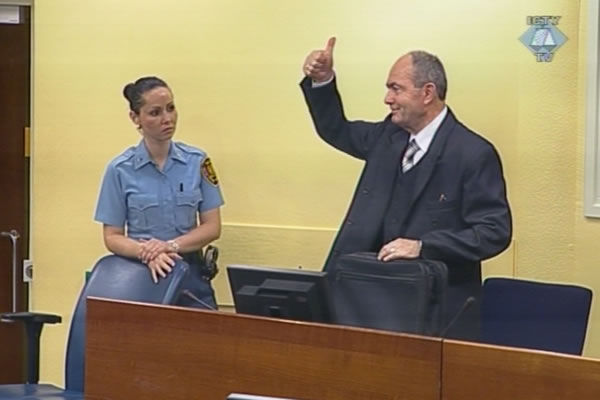 Zdravko Tolimir in the courtroom
  Zdravko Tolimir in the courtroom
 The Trial Chamber, with Judge Christoph Fluegge from Germany presiding and judges Prisca Nyambe of Zambia, and Antoine Mindua, of Congo found with a majority of votes that Zdravko Tolimir was guilty of genocide, conspiracy to commit genocide, extermination, murder, persecution and forcible transfer of the population of Srebrenica and Zepa in July 1995. The Trial Chamber sentenced Tolimir to life imprisonment. In her dissenting opinion, Judge Nyambe said that the responsibility of the accused was not established beyond reasonable doubt.
The majority ruled that Mladic’s former assistant for security and intelligence in the VRS Main Staff participated in two joint criminal enterprises and was responsible for crimes committed to implement them – killing thousands of able-bodied Muslim men after the fall of Srebrenica and Zepa and forcible transfer of the Muslim population from the eastern enclaves.
In the view of the majority, the abuse of the detained men inflicted terrible bodily and mental suffering on the prisoners and constituted an act of genocide. Also, it was established that removing the Muslim civilian population from Zepa, demolishing their homes and mosques as well as killing three of the most distinguished persons in the enclave – Avdo Palic, Mehmed Hajric and Amir Imamovic – were carried out to make sure the Muslim community in the enclave would not reconstitute; this amounted to the crime of genocide. This is the Tribunal’s first judgment for crimes committed in July 1995 in the Zepa enclave.
By applying the conservative method to calculate the minimum number of victims, the judges, Judge Nyambe dissenting, concluded that at least 4,970 Muslim men were killed in Srebrenica in the summer of 1995. Realistically, the majority concluded, the minimum number of killed men was closer to 6,000.
Crimes committed within the two joint criminal enterprises were ‘massive in scale, severe in their intensity and devastating in their effect’. In deliberating on the judgment in this case, the Trial Chamber took into consideration the ‘extreme suffering of the approximately 35,000 women and children forcibly removed from the eastern enclaves and their inability to live a normal and constructive life to this day’.
In determining the sentence, the majority primarily considered the gravity of crimes and contribution of the accused to the execution of thousands of men and boys as part of an organized operation aimed at annihilating the Muslim population from that part of BH. With respect to aggravating circumstances, the judgment stated the accused’s high rank and central position within the VRS Main Staff, his duty and failure to ensure the safety of thousands of prisoners, his deliberate and active involvement in two joint criminal enterprises and abuse of his position in an attempt to cover up the crimes by transferring the bodies. The only factor in mitigation was Tolimir’s ‘good behavior’ during the trial but it was given little weight in determining the sentence, the majority of the Trial Chamber concluded.
About a dozen women from the Mothers of Srebrenica association followed the reading of Tolimir’s judgment from the public gallery. When the accused was found guilty of the crime of genocide, they breathed audible sighs of relief and applauded when the life sentence was imposed.
 Zdravko Tolimir in the courtroom
 At a regular status conference in the appellate proceedings against Zdravko Tolimir, Mladic’s former assistant for security and intelligence in the VRS Main Staff, pre-trial judge Theodor Meron ordered the defense and the prosecution to prepare and submit the redacted ‘public versions’ of their appellate briefs by 27 March 2014.
The Trial Chamber found Tolimir guilty and sentenced him to life for the genocide in Srebrenica. Tolimir submitted his appellate brief as a confidential document. As a result, the prosecution’s response was also filed as a confidential document. The prosecution didn’t appeal against the trial judgment. Highlighting the ‘general importance of transparent proceedings’ before an international court, Judge Meron recalled that the Tribunal’s Statute guaranteed a ‘public trial’. According to the Rules of Procedure and Evidence, all cases should be heard by the Appeals Chamber in open court, Judge Meron recalled, except when there were extraordinary reasons for the hearings to be held behind closed doors. All confidential information must be redacted from the public versions of the briefs, the judge ordered.
Since the prosecution’s brief was just a response to Tolimir’s appellate brief, the prosecution sought permission to file the public version some days after the defense has filed its brief. The prosecution would thus have the opportunity to see what Tolimir and his team want to keep confidential and unavailable to the public. Judge Meron instructed the prosecution to submit a written request. The Appeals Chamber will render its decision later.
Zdravko Tolimir didn’t have any complaints about the conditions in the Detention Unit or any other objections regarding his health. At the beginning of the status conference, Tolimir wished everyone a ‘day pleasing to God’, as has been his custom. He also expressed his desire that the ‘status conference ends in line with God’s will and providence – as it is most agreeable to God and most useful for our souls’.
In line with the Tribunal’s rules, the next status conference should be scheduled not later than 120 days from today.
 Zdravko Tolimir in the courtroom
 It took only six minutes to conclude the regular status conference in the appellate proceedings against Zdravko Tolimir, Mladic’s assistant for security and intelligence. Replying to the usual question about health and conditions in the detention unit, Tolimir briefly reported that his ‘health status is unchanged’. Tolimir had no complaints or questions.
Presiding judge Theodor Meron then announced that the appellate hearing in the case would take place on 12 November 2014.Only Tolimir appealed against the trial judgment, handed down in December 2012. The Trial Chamber found Tolimir guilty of genocide in Srebrenica in July 1995 and sentenced him to life in prison.
Tolimir has listed 25 grounds of appeal contesting the factual and legal findings in the trial judgment. In Tolimir’s view, the sentence is ‘obviously too harsh’. According to the prosecution, the Trial Chamber has adequately assessed the evidence and has imposed an adequate sentence.
At the appellate hearing scheduled to begin at 9:50am, Tolimir will be the first to address the judges and will havetwo hours to present his arguments. The prosecution will have the same amount of time to respond to Tolimir’s appeal. Tolimir will then have an hour and half to reply, and will be given an opportunity to address the Appeals Chamber at the end of the hearing for ten minutes.
Tolimir's legal advisor Aleksandar Gajic will also present oral arguments at the appellate hearing. The appellate judgment in the case against Zdravko Tolimir is expected in the spring of 2015.
Zdravko Tolimir in the courtroom In December 2012, the Trial Chamber found Zdravko Tolimir, Ratko Mladic’s assistant for security and intelligence in the VRS Main Staff, guilty of genocide, complicity in genocide, extermination, murder, persecution and forcible transfer of the population of Srebrenica and Zepa in July 1995. Tolimir was sentenced to life in prison. An oral hearing was held today at the Tribunal on Tolimir’s appeal against the trial judgment.
In his submission, Tolimir stated 25 grounds of appeal contesting the factual and legal findings of the Trial Chamber. During the appellate hearing Tolimir’s legal advisor Aleksandar Gajic mostly replied to the Appeals Chamber’s questions. The appellate judges asked if the VRS operations in Zepa could be qualified as genocidal, if they were considered separately from Srebrenica. Also, the judges asked if the Trial Chamber erred when it concluded that the Muslim community leaders in Zepa – Mehmed Hajric, Amir Imamovic and Avdo Palic – were killed with a specific intent to destroy a part of the Muslim population in Zepa.
In the defense’s view, there was no evidence in the case that the VRS had a genocidal intent in respect of the Zepa population and that genocide was committed. In Zepa there were no prisoners of war and civilians were not killed. The murder of three Muslim leaders – regardless of their positions as members of the wartime presidency – couldn’t be interpreted as an act of genocide, Tolimir’s defense claimed. According to the defense, ‘genocide is not a crime against an individual but against a nation, religious or ethnic group’. All three leaders were killed after the population had left Zepa, the defense stressed. At that time, ‘their importance for the survival of the community was not the same as it was before’.
The judges in the Appeals Chamber were also keen to learn if the parties believed the Trial Chamber erred when it concluded that Tolimir ‘knew’ that his subordinates played part in the joint criminal enterprise and if he ‘intended to take part in it’. Tolimir was the chief of security and intelligence in the Main Staff at the time. In the judgment, the Trial Chamber ruled that it was ‘unimaginable’ that Tolimir – given his position – had noknowledge of his subordinated officers killing Muslim prisoners.
According to the defense, Tolimir didn’t know about any murders because no one had informed him about them. One of the crucial documents is Tolimir’s instruction to organize accommodation for detained Muslims in ‘enclosed locations’ so that they couldn’t be photographed from the ground or air. According to the defense, the document was a forgery. The defense insistedthat the document wasn’t part of an attempt to hide the prisoners who were to be executed. On the contrary, the document spoke about finding ‘adequate accommodation’ for the prisoners. The intercepts were ‘misinterpreted’, and the documents were ‘not translated correctly’, the defense argued. In brief, there is no evidence that Tolimir knew about the killings and that he participated in them. Consequently, Tolimir should be acquitted on all counts in the indictment.
The prosecution’s view on the issues is the exact opposite. Prosecutor Peter Kremers holds that the Zepa issue was inseparable from the Serb military operation in Srebrenica. Also, in the prosecutor’s opinion, the Trial Chamber was correct in its assessment of Tolimir’s role in the operations in Srebrenica and Zepa. The accused was one of the ‘key players in the operation to killthe prisoners’, and later in the efforts to cover up the crimes, the prosecutor stressed.
At the end of the hearing, Tolimir took the opportunity to address the Appeals Chamber. Tolimir said that he found it ‘strange’ that he and other VRS officers were indicted because they had defended Republika Srpska. The constitution dictated it, Tolimir noted. After that Tolimir spoke in detail about NATO’s ‘aggression’ against Republika Srpska and the Federal Republic of Yugoslavia. That, in Tolimir’s words, showed that the international community was ‘biased’ and favored some of the partiesin the conflict.
The presiding judge Theodor Meron concluded the appellate hearing after Tolimir's address, indicating that the appeals judgment would be rendered in due time.
 Zdravko Tolimir in the courtroom
 Zdravko Tolimir, Ratko Mladic's former assistant for security and intelligence in the Republika Srpska Army Main Staff, appeared at the status conference in his appellate proceedings, probably for the last time before the appellate judgment is rendered. The plan is for the judgment to be handed down in March 2015.
In December 2012, the Trial Chamber found Tolimir guilty of genocide, complicity to commit genocide, killing, persecution and forcible removal of the population of Srebrenica and Zepa in July 1995. In his appeal against the trial judgment the former chief of security and intelligence in the VRS Main Staff contested the findings in 25 grounds of appeal. The prosecution has not appealed against the Trial Chamber's judgment.
At a brief status conference, Judge Theodor Meron recalled that the appellate hearing in the Tolimir case was held in November 2014. The five judges in his panel are working on the final judgment, the presiding judge said, but did not specify the date on which the judgment would be handed down.
Asked about his health and the conditions in the detention unit, Tolimir replied that he had some health problems: 'four stents have been inserted’ into his blood vessels, Tolimir explained. The accused requested that the medical records of the procedure be disclosed to him and to the Appeals Chamber.
Zdravko Tolimir in the courtroom The Appeals Chamber of the International Criminal Tribunal for the former Yugoslavia will hand down the final judgment in the case against Zdravko Tolimir, former Mladic’s assistant for security and intelligence in the VRS Main Staff, on Wednesday, 8 April 2015. In December 2012, the Trial Chamber found Tolimir guilty of genocide, complicity to commit genocide, extermination, murder, persecution and forcible evacuation of the population of Srebrenica and Zepa in July 1995. Tolimir was sentenced to life.
At the appellate hearing in November 2014, the judges heard arguments concerning Tolimir’s appeal. The discussion focused on two issues: first, whether the VRS operation in Zepa could be qualified as genocidal if it were considered separately from the crimes in Srebrenica, and secondly, whether the Trial Chamber erred when it concluded that, given his position, Tolimir had known that his subordinates were part of a joint criminal enterprise which comprised the killings, and whether Tolimir ‘intended to participate in the joint criminal enterprise’.
The defense argued that there was no evidence of the VRS’s genocidal intent against the people of Zepa or that genocide had been committed. The prosecution’s evidence on Tolimir’s involvement in the crimes was ‘falsified’, the defense claimed. Also, according to the defense, intercepted conversations were ‘misinterpreted’ and the documents were ‘mistranslated’. Consequently, the defense called for Tolimir’s acquittal on all counts in the indictment. The position of the prosecution on all those issues was diametrically opposed. According to the prosecution, Tolimir was ‘one of the key players in the operation to kill the prisoners’, and the subsequent efforts to cover up the crimes.
The indictment against Zdravko Tolimir was confirmed and made public in February 2005. In late May 2007, Tolimir was arrested at the border between Serbia and BH. Soon afterwards, Tolimir was transferred to the Tribunal’s Detention Unit. His trial began in February 2010 and was completed in August 2012.
 Zdravko Tolimir in the courtroom
 The Appeals Chamber unanimously confirmed the life sentence for Zdravko Tolimir. With a majority of votes, the five-member panel has rejected most of the 25 grounds of appeal put forth by the former chief of security and intelligence in the VRS Main Staff in a bid to have the Trial Chamber’s findings reversed.
In December 2012, the Trial Chamber found Tolimir guilty of genocide, complicity to commit genocide, extermination, murder, persecution and forcible transfer of the population of Srebrenica and Zepa in July 1995.
The Trial Chamber concluded in its judgment that Tolimir had ‘actively participated and significantly contributed’ to the implementation of two joint criminal enterprises. The Appeals Chamber has accepted the conclusion. The two enterprises involve the killing of the men of military age from Srebrenica and the expulsion of the Muslim civilians from Srebrenica and Zepa. The result was a ‘mass execution of thousands of Bosnian Muslims from Srebrenica and the forcible transfer of thousands of civilians from the both enclaves'.
The Appeals Chamber has in part or in whole granted nine of the 25 grounds of appeal put forth by Tolimir, noting that the Trial Chamber ‘erred in law' in some parts of the judgment, and that some of the Trial Chamber’s findings were ‘insufficiently explained’. The genocide conviction has been modified, but only insofar as it pertains to Tolimir’s responsibility for the ‘killing of three Muslim leaders in Zepa after the forcible transfer of the population of the enclave’. The appellate judges stress that the ‘Bosnian Muslims of Žepa were, along with the Muslims of Srebrenica and Eastern BiH, the victims of genocide’. The murder of three Zepa leaders – Avdo Palic, Mehmed Hajric and Amir Imamovic – was a war crime and a crime against humanity, the Appeals Chamber noted in its judgment.
The appellate judgment acquits Tolimir of the crime committed by the Scorpions unit: the killing of six prisoners from Srebrenica in late July 1995 near the village of Trnovo. According to the Appeals Chamber, the link between the direct perpetrators, who were all members of the special police unit nicknamed the Scorpions, and the participants in the joint criminal enterprise hasn’t been established sufficiently.
The acceptance of some of Tolimir's grounds of appeal and the partial reversal of some convictions from the trial judgment has not affected the length of the sentence. Zdravko Tolimir is the fourth accused to receive the harshest sentence at the Tribunal's disposal: life imprisonment. Stanislav Galic was sentenced to life for the artillery and sniper terror campaign in Sarajevo, and Vujadin Popovic and Ljubisa Beara were sentenced to life for the Srebrenica genocide.
Zdravko Tolimir in the courtroom Zdravko Tolimir, who was the assistant for security and intelligence to the VRS Main Staff commander during the war in BH, passed away in the UN Detention Unit in Scheveningen in the night of 8 February 2016, the Mechanism for International Criminal Tribunals has announced. According to the Dutch law and standard procedure, the Dutch authorities have opened an inquest into Tolimir’s death. Judge Theodor Meron, the President of the Mechanism, has also ordered an enquiry and has put Judge Vagn Joensen in charge.
Tolimir was in the Tribunal’s Detention Unit awaiting transfer to a country where he would serve his life sentence. In December 2012 the Trial Chamber found Tolimir guilty of genocide, complicity to commit genocide, extermination, murder, persecution and forcible transfer of Srebrenica and Zepa population in July 1995.
In April 2015, the Appeals Chamber confirmed the judgment accepting the Trial Chamber’s findings that Tolimir had ‘actively participated and significantly contributed’ to the implementation of two joint criminal enterprises – the killing of able-bodied men from Srebrenica and the expulsion of the Muslim population from Srebrenica and Zepa. As a result, ‘thousands of Bosnian Muslims from Srebrenica were executed and thousands of civilians from the two enclaves were forcibly removed’.
Tolimir was transferred to the Tribunal’s Detention Unit in June 2007. At the beginning, Tolimir complained of ill health as he survived a few strokes. As time went by,Tolimir recovered thanks to ‘prayers and herbal infusions’, as he explained. The last time Tolimir addressed the issue of his health was in February 2015, when he told the pre-appeal judge about his heart surgery. The surgeons put four stents in his blood vessels.
Zdravko Tolimir in the courtroom The Dutch authorities have informed the Mechanism for the International Criminal Tribunals that according to the autopsy results, Zdravko Tolimir died of natural causes. The autopsy has been carried out as part of the standard procedure mandated under the Dutch law. Tolimir passed away on 9 February 2016 in the UN Detention Unit in Scheveningen.
In its announcement the Mechanism didn’t specify the cause of death of the former assistant to the commander of the VRS Main Staff for security and intelligence. Tolimir was sentenced to life in prison for his involvement in genocide and other crimes in Srebrenica and Zepa in 1995. The last time Tolimir spoke about his health was in February 2015: he told Judge Meron that he had had three stents implanted in his heart.
 Judge Vagn Joensen
 On 8 February 2016, Zdravko Tolimir died in the UN Detention Unit. He was awaiting transfer to a prison where he was to serve his life sentence. He was convicted by the Tribunal for the Srebrenica genocide. The Tribunal launched an internal enquiry to determine the circumstances and cause of Tolimir’s death. The enquiry was led by Danish judge Vagn Joensen. It took seven months, mostly because the Dutch Forensic Institute did not submit a detailed report on Tolimir’s autopsy to the Mechanism for International Criminal Tribunals until 15 August. The report confirmed the preliminary findings of the initial post mortem and the enquiry conducted by the Dutch public prosecutor’s office: Tolimir’s death was natural, caused by a heart attack.
Joensen’s report describes in detail the state of Tolimir’s health in 2007, when he arrived in the UN Detention Unit. At his initial appearance before a Tribunal’s judge, Tolimir said he had had a series of stroked while he had been at large. On his arrival in The Hague, Tolimir was diagnosed with some cardiac anomalies, but he refused to undergo further exams and treatment, according to Joensen’s report.
Despite his refusal to take any medication, Tolimir’s health improved significantly in detention. In 2015, he started having heart problems. In January 2015, he was fitted with an implantable heart defibrillator. In 2015, he suffered a series of heart attacks. The guards and the medical personnel in the UN Detention Unit were able to revive him every time, until the fatal heart attack that occurred on 8 February 2016.
Although all efforts to resuscitate him were in vain, Judge Joensen’s report describes the intervention of the Detention Unit personnel as ‘prompt, efficient and coordinated’ and states that the health care standard enjoyed by the Tribunal’s detainees is equal to that of Dutch citizens in the Netherlands.